FAQ :About For Real Estate
This section provides important information about RADON testing and mitigation in the context of Real Estate Transactions.
You’ll learn how RADON levels can affect property value, when to test during a sale or purchase, and how mitigation systems can be integrated into the home inspection process.
These FAQs are designed to help buyers, sellers, and real estate professionals understand their roles and responsibilities, ensuring transparency, compliance, and a healthier indoor environment for future homeowners.
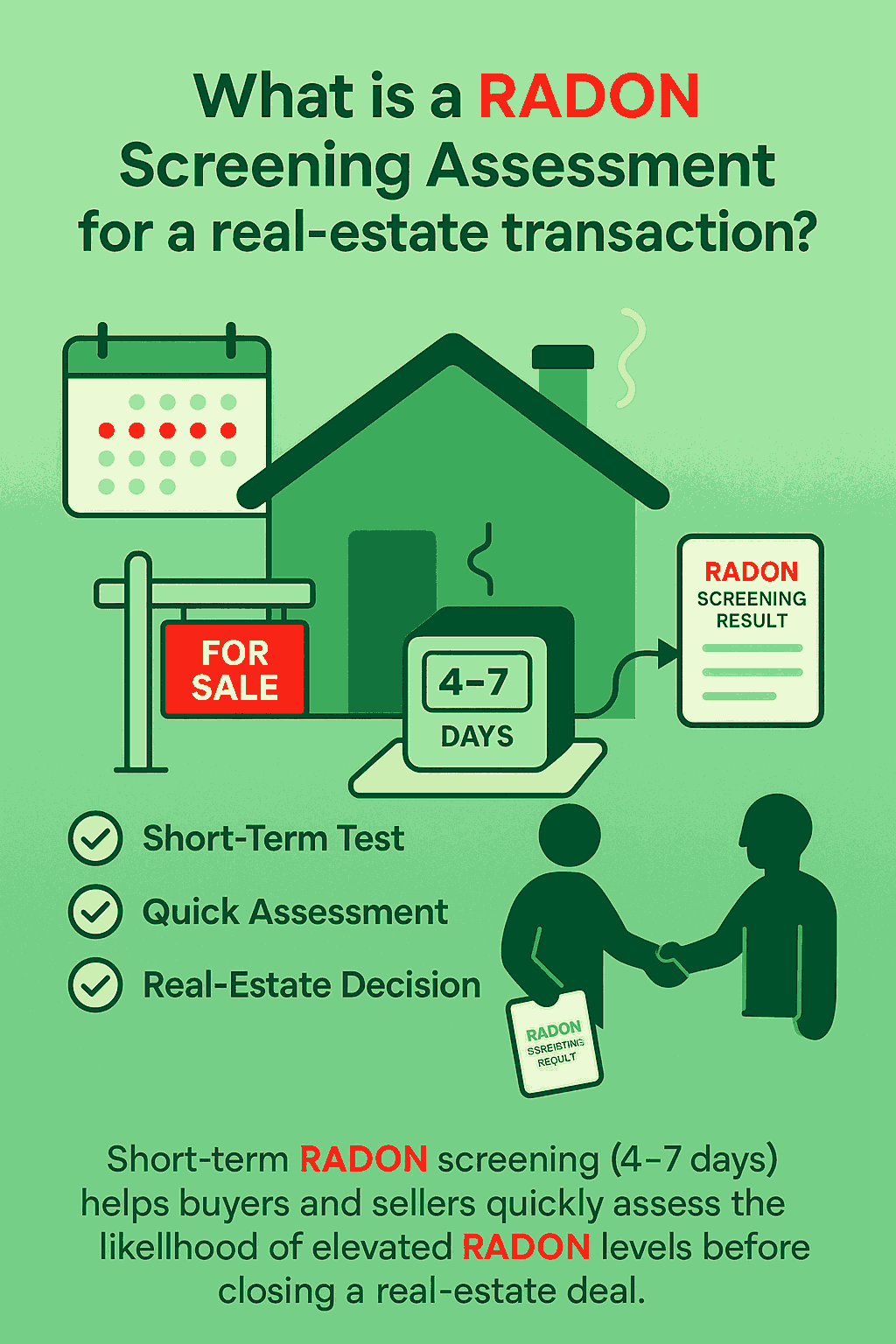
A RADON Screening Assessment is a short-term test, usually lasting between 4 and 7 days, conducted during a real-estate transaction.
It provides a quick snapshot of the home’s RADON levels to help buyers and sellers understand whether further long-term testing or mitigation may be needed.
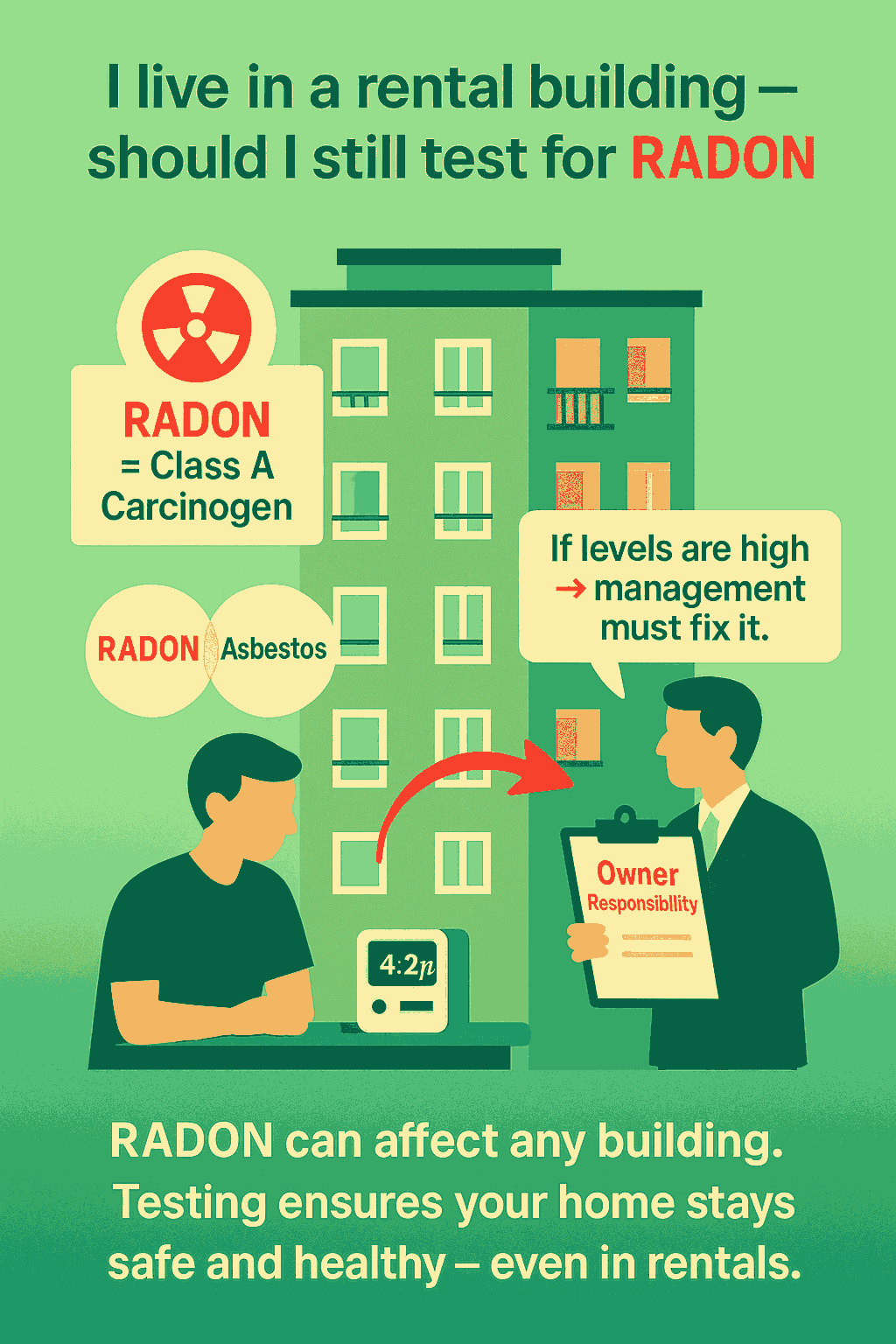
Yes. Even in rental properties, testing for RADON is important. RADON is a Class A carcinogen, similar to asbestos, and the responsibility to fix high levels lies with the building owner or management.
While high-rise apartments usually have lower RADON levels, converted or older buildings can still be at risk. Testing ensures that your living space remains safe and healthy.
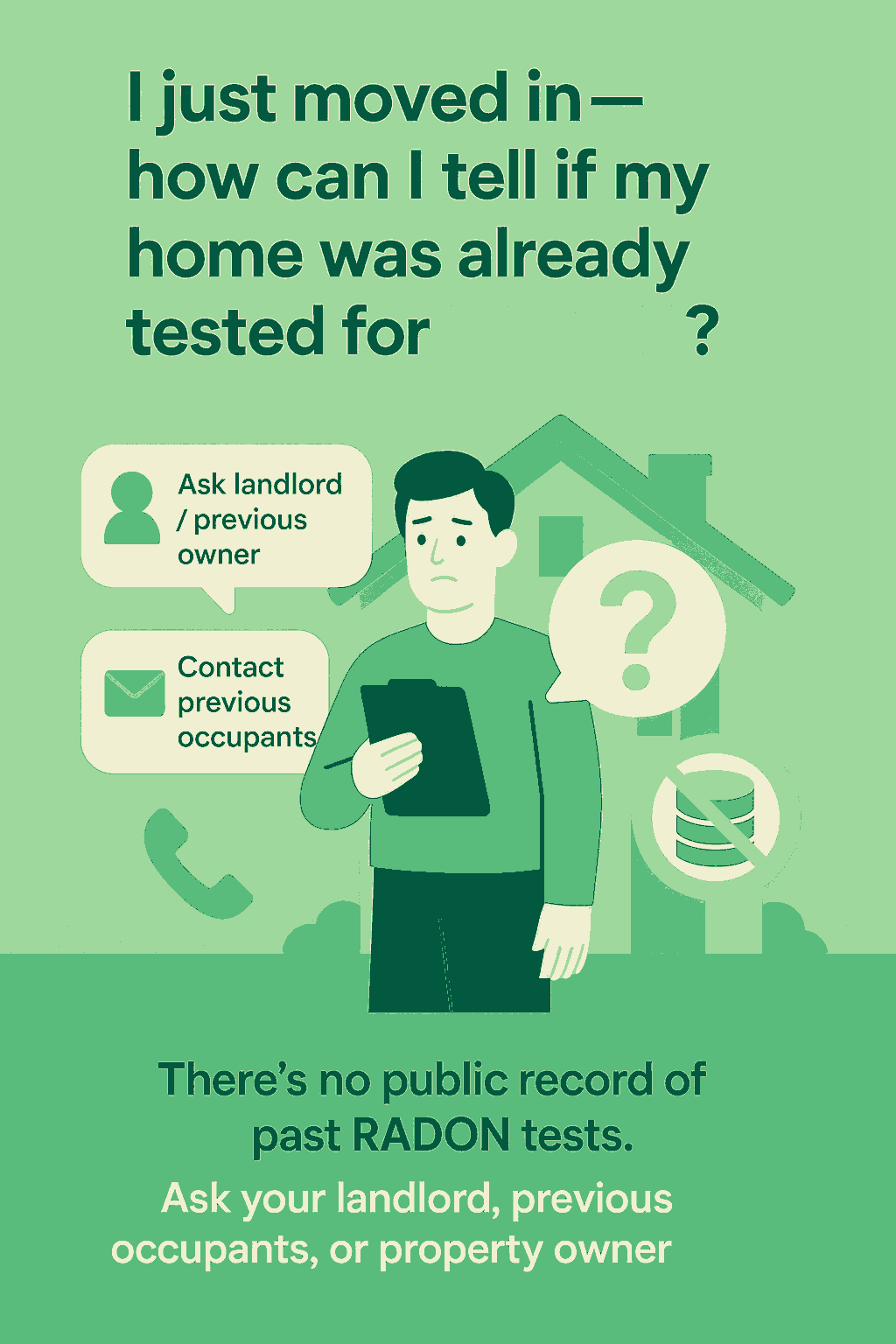
There’s currently no public database that tracks past RADON tests. The best way to find out is to ask the previous occupants, landlord, or property owner if any RADON testing was done.
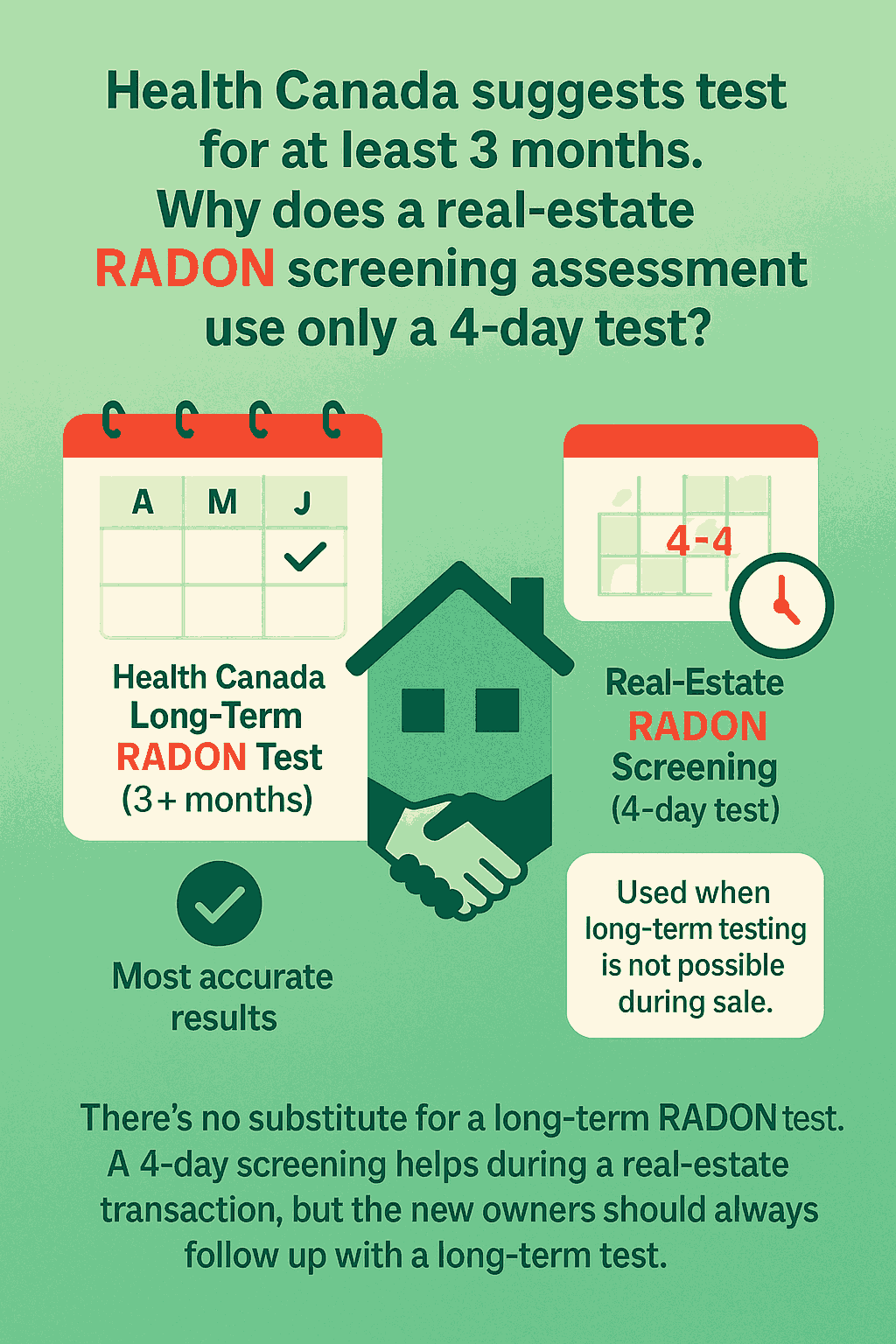
Health Canada recommends a long-term RADON test (at least 3 months) for the most accurate results.
However, during a real-estate transaction, time is often limited. A short-term RADON screening (about 4 days) can provide a quick indication of whether high RADON levels might be present.
If no long-term test was done before listing the home, this screening helps buyers and sellers understand if future mitigation costs may be needed.
Once the new owners move in, a long-term RADON test should still be completed to confirm the home’s true RADON level.
RADON is a serious health concern that more Canadians are becoming aware of.
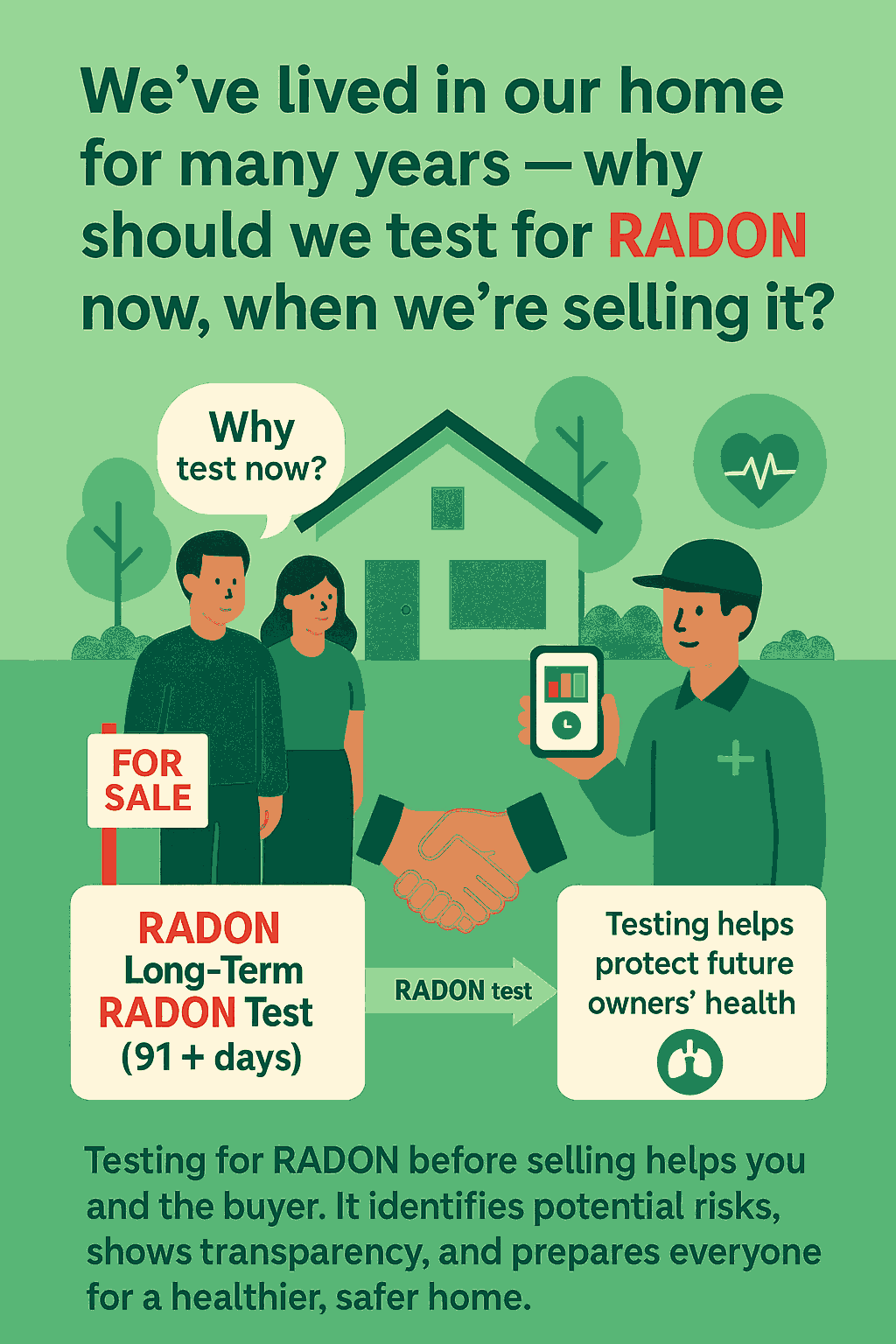
Testing is the only way to know your home’s RADON level and whether it needs to be reduced.
Just as a home inspection informs buyers of potential repairs or costs, a RADON screening assessment shows whether a mitigation system might be needed. Including this information helps buyers plan ahead and shows that you’ve taken steps to address an important health and safety issue.
Not at all.
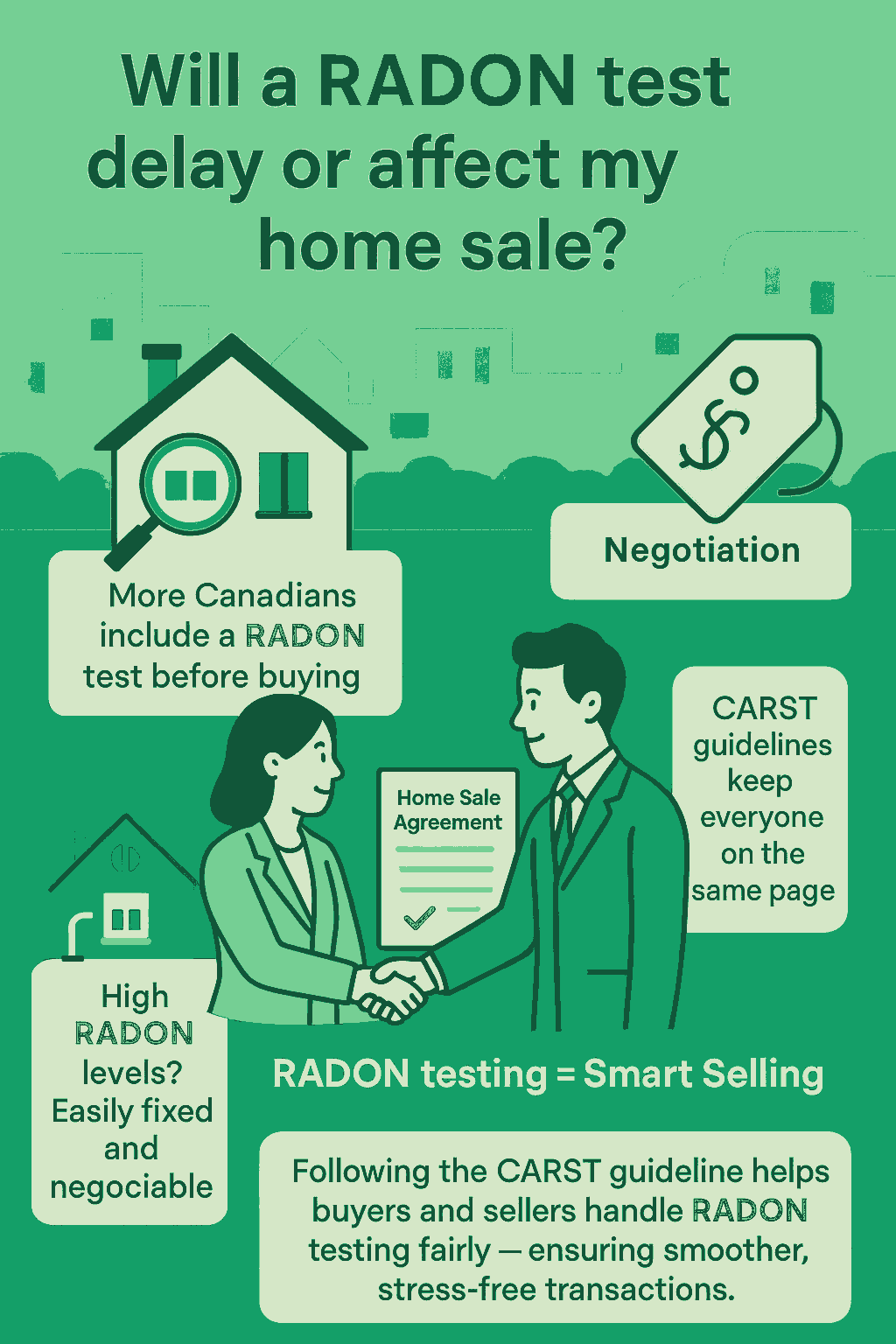
In fact, more home buyers across Canada now include a RADON test during the purchase process.
In some regions, every home is tested for RADON before being sold.
CARST’s real-estate guideline helps buyers and sellers handle RADON testing smoothly and fairly. Just like an older furnace or worn roof shingles, high RADON levels can be fixed - and the cost can simply be part of the price negotiation.
By following this approach, everyone involved in the sale stays on the same page, reducing stress and avoiding misunderstandings.
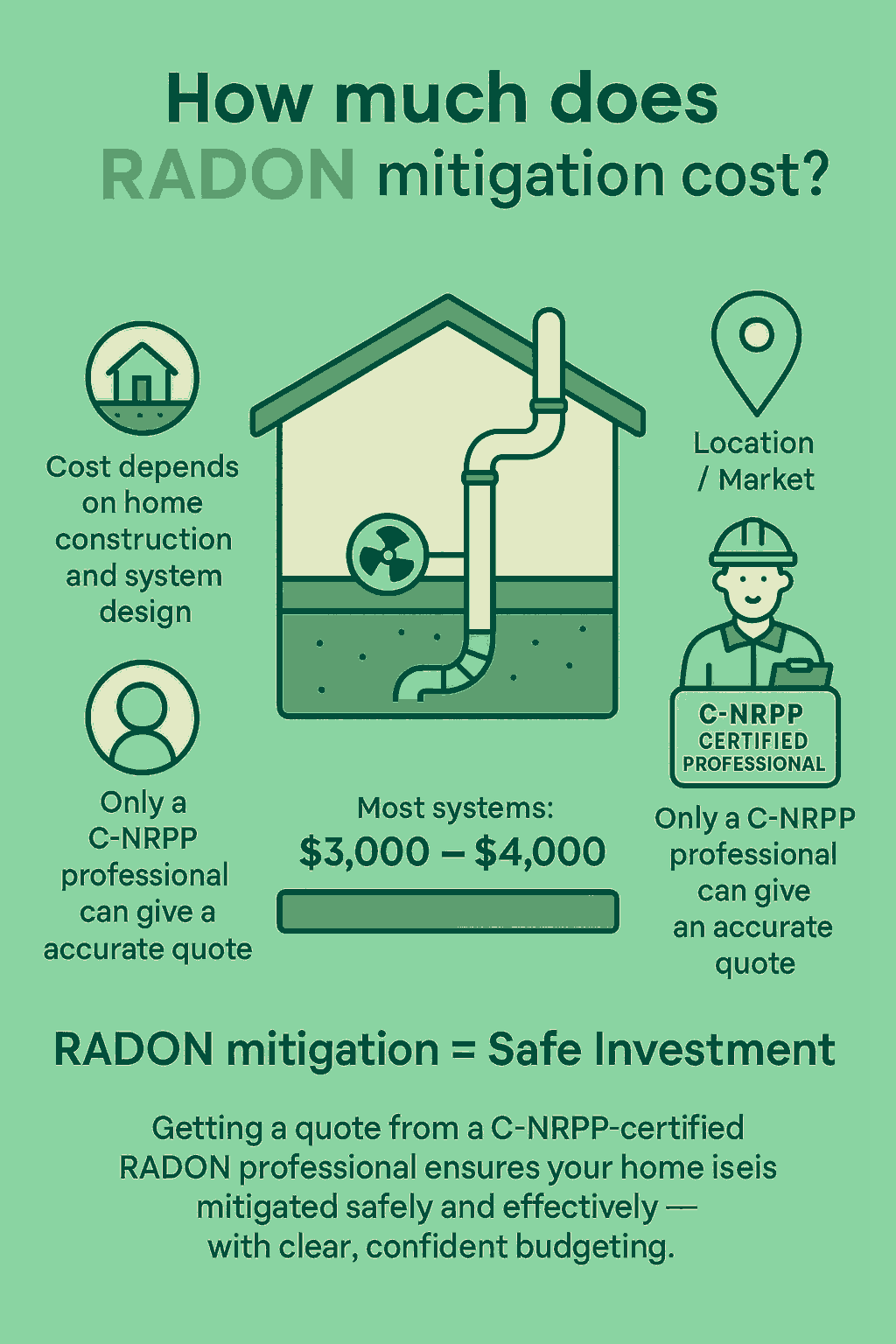
The cost of a RADON mitigation system depends on several factors - your home’s construction type, the system design, location, and market conditions.
Because every home is different, only a C-NRPP-certified professional can accurately assess the work required and provide a proper quote.
In most cases across Canada, the cost ranges from $3,000 to $4,000, though complex projects can reach over $10,000.
Getting a professional estimate ensures your RADON levels are reduced safely and effectively.
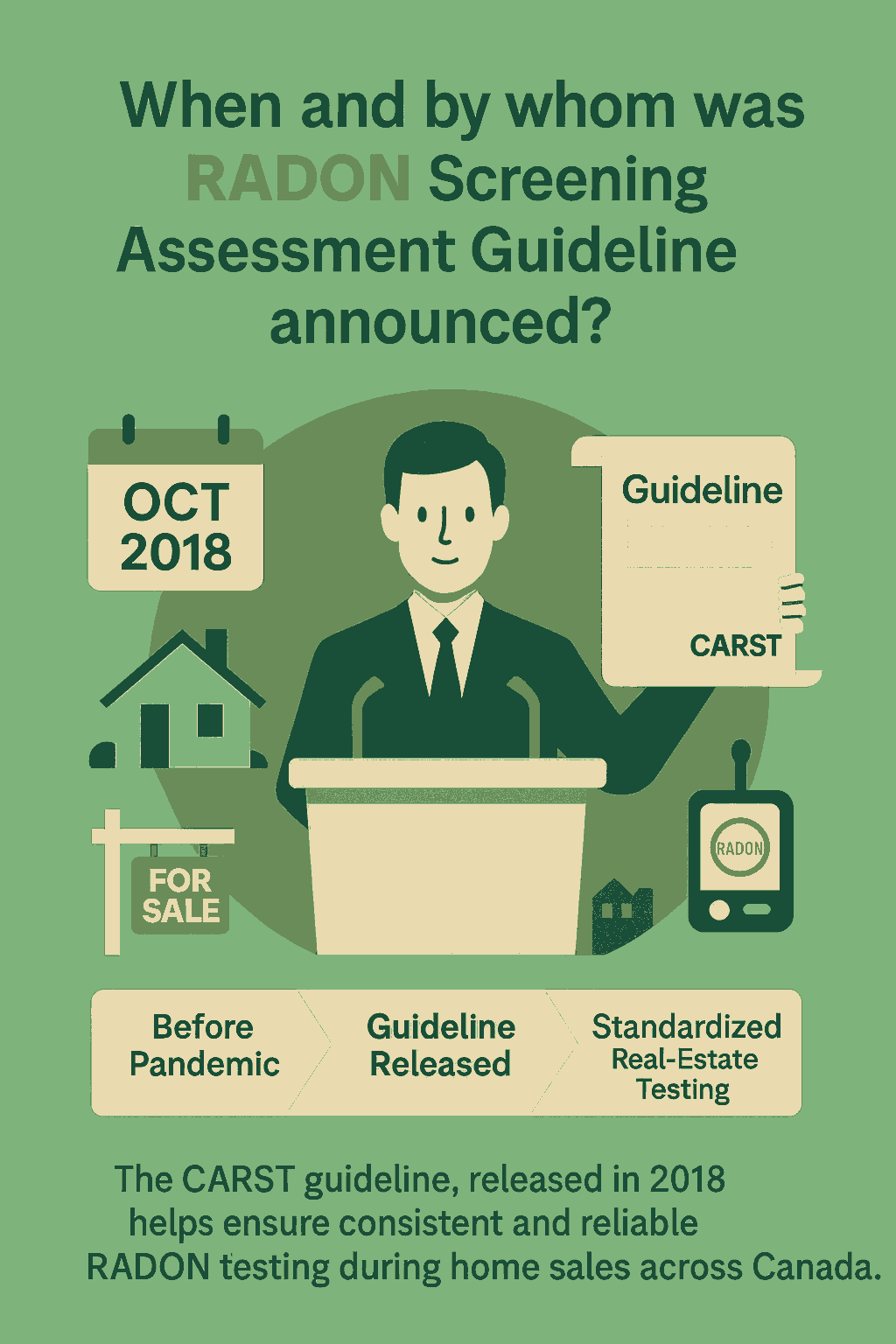
The RADON Screening Assessment Guideline for real estate transactions was announced to the public in October 2018 by CARST - the Canadian Association of Radon Scientists and Technologists.
It was released just before the pandemic to help standardize how RADON testing is handled during home sales across Canada.
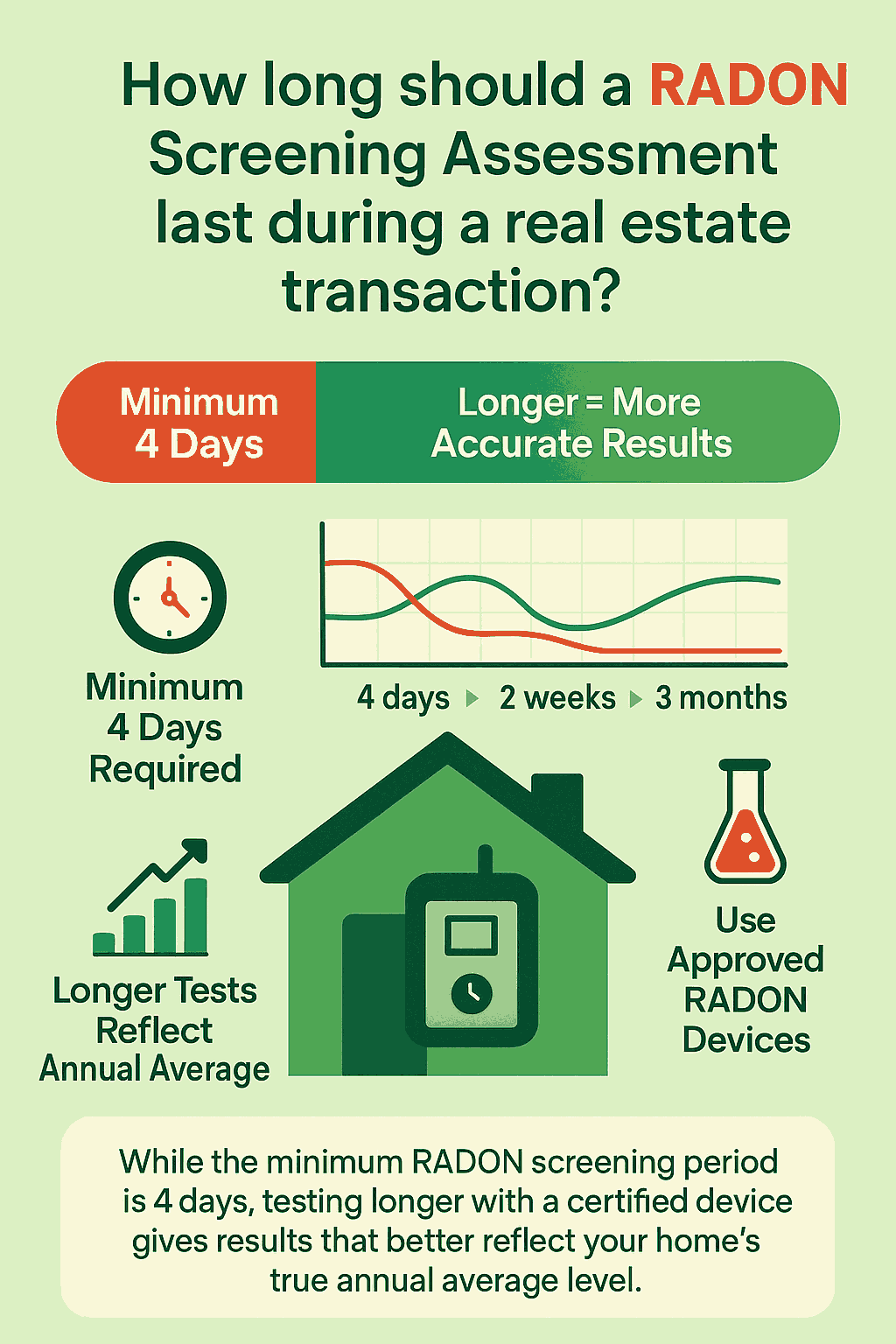
The minimum testing period is 4 days. However, research shows that longer tests provide results closer to the true annual average RADON level in a building.
Whenever possible, homeowners or buyers should test for the longest available period using a properly approved RADON device for the most accurate results.
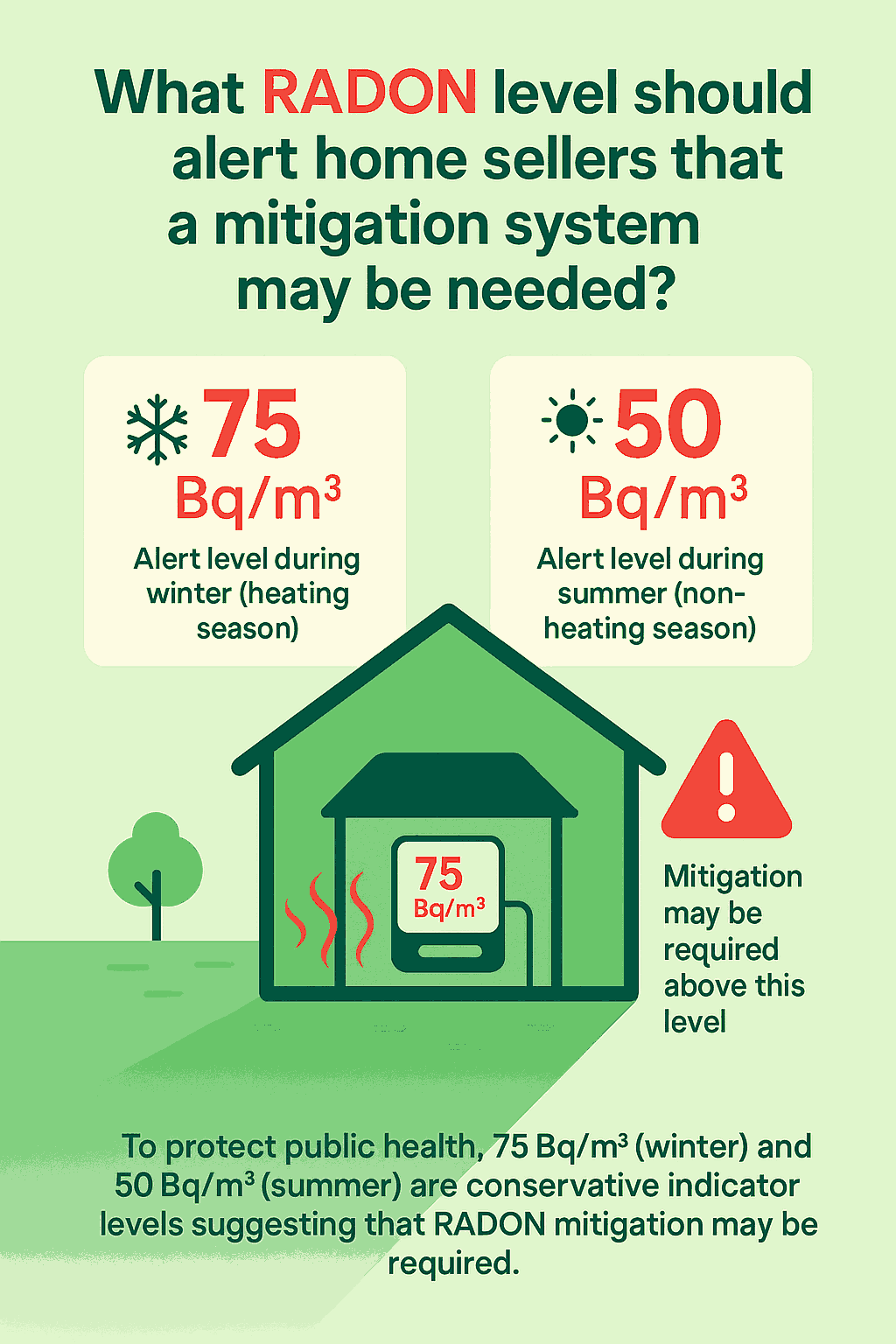
To help protect public health, the guideline suggests:
- 75 Bq/m³ during the winter or heating season, and
- 50 Bq/m³ during the summer or non-heating season.
If test results are above these levels, it may indicate that a RADON mitigation system could be required to reduce exposure.
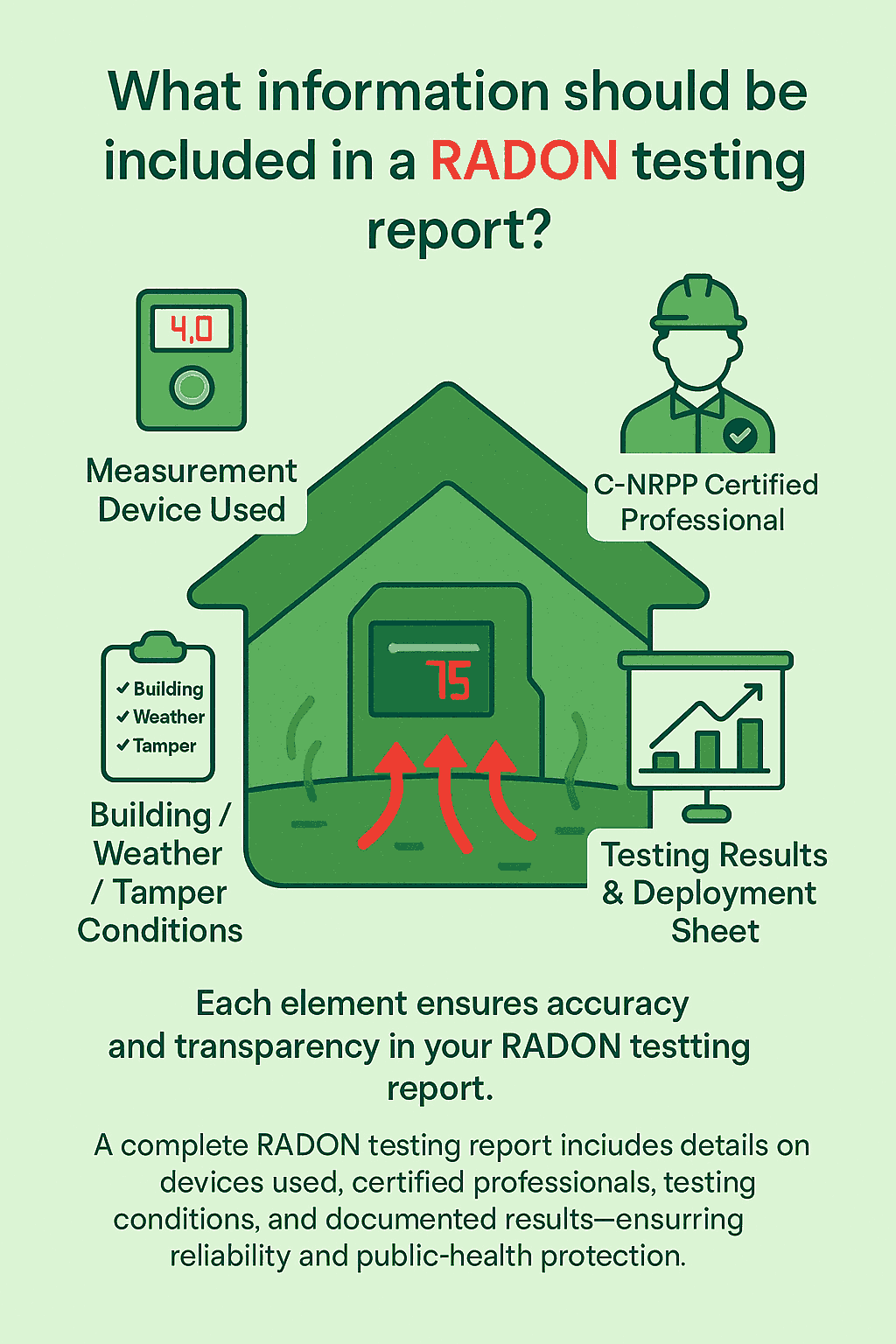
A proper RADON testing report should include:
- The specific measurement devices used
- The C-NRPP-certified professional who conducted the test
-
The testing conditions, including:
- Building condition
- Weather condition
- Tamper controls
- The testing results and deployment sheet documenting when and where the test was performed.
These details ensure the report is accurate, transparent, and compliant with professional RADON testing standards.
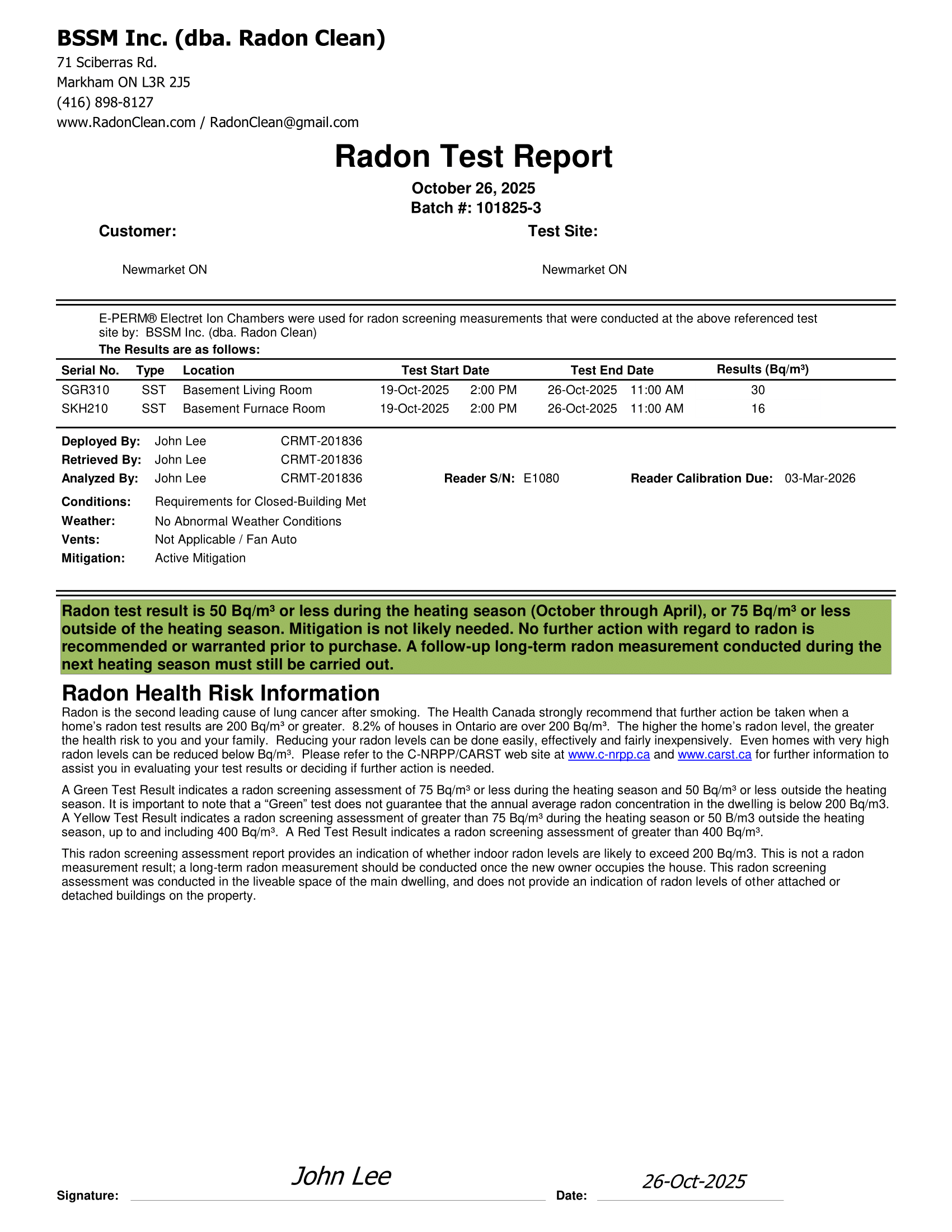
A Sample Green Letter or RADON Test Report is an official document that summarizes the results of a professional RADON screening assessment. It is typically issued by a certified tester such as Radon Clean using devices like the E-PERM® Electret Ion Chamber.
It includes key details such as:
- Test location and duration (start and end dates)
- Measurement devices used
- RADON levels measured (in Bq/m³)
- Weather and testing conditions
- Professional analysis and recommendations
To make it easy to interpret, results are color-coded: 🟩 Green →
- Low RADON levels (≤ 75 Bq/m³ in heating season, ≤ 50 Bq/m³ otherwise)
- No immediate action required, but a follow-up long-term test is advised
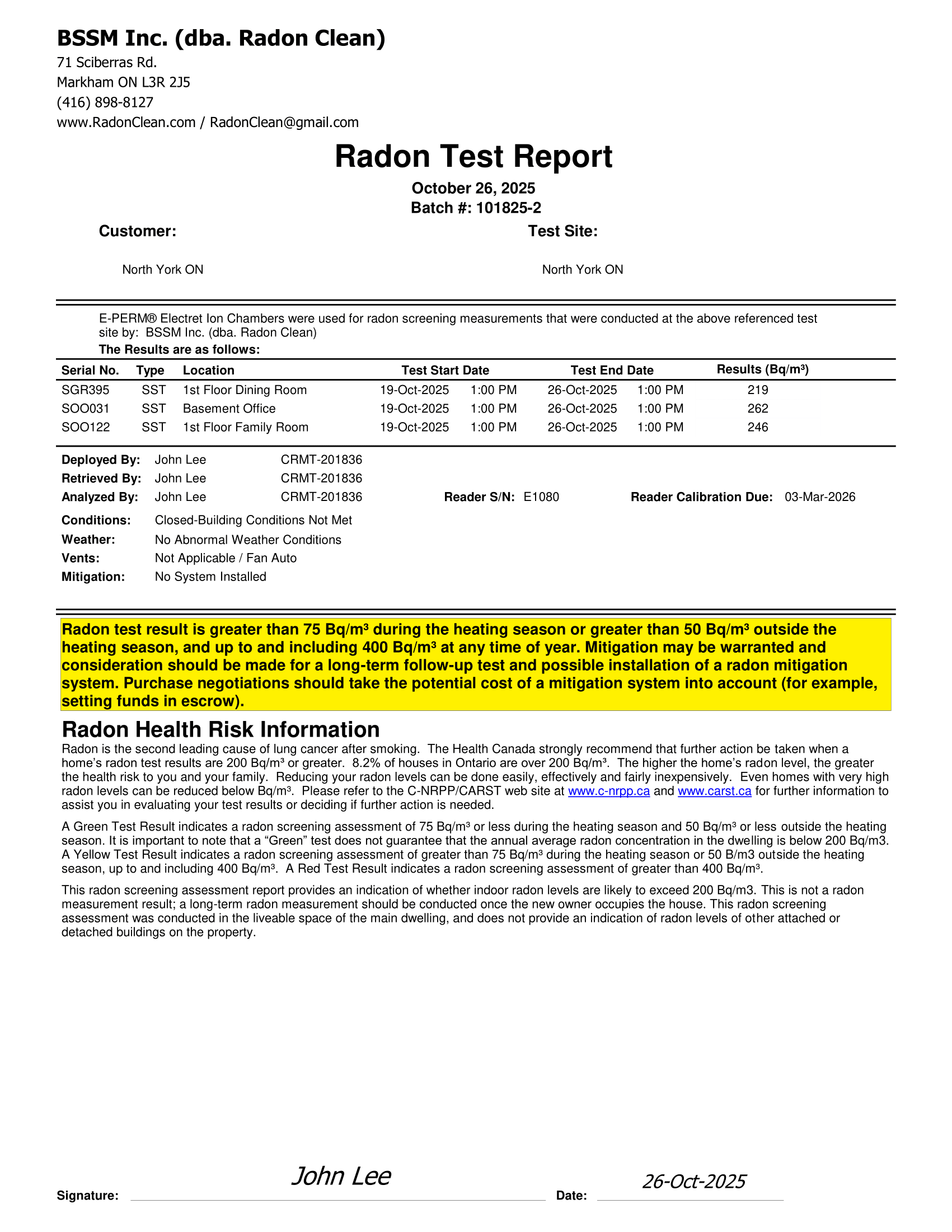
A Sample Yellow Letter or RADON Test Report is an official document that summarizes the results of a professional RADON screening assessment. It is typically issued by a certified tester such as Radon Clean using devices like the E-PERM® Electret Ion Chamber.
It includes key details such as:
- Test location and duration (start and end dates)
- Measurement devices used
- RADON levels measured (in Bq/m³)
- Weather and testing conditions
- Professional analysis and recommendations
To make it easy to interpret, results are color-coded : 🟨 Yellow
- Moderate RADON levels (up to 400 Bq/m³)
- - Further testing and possible mitigation recommended
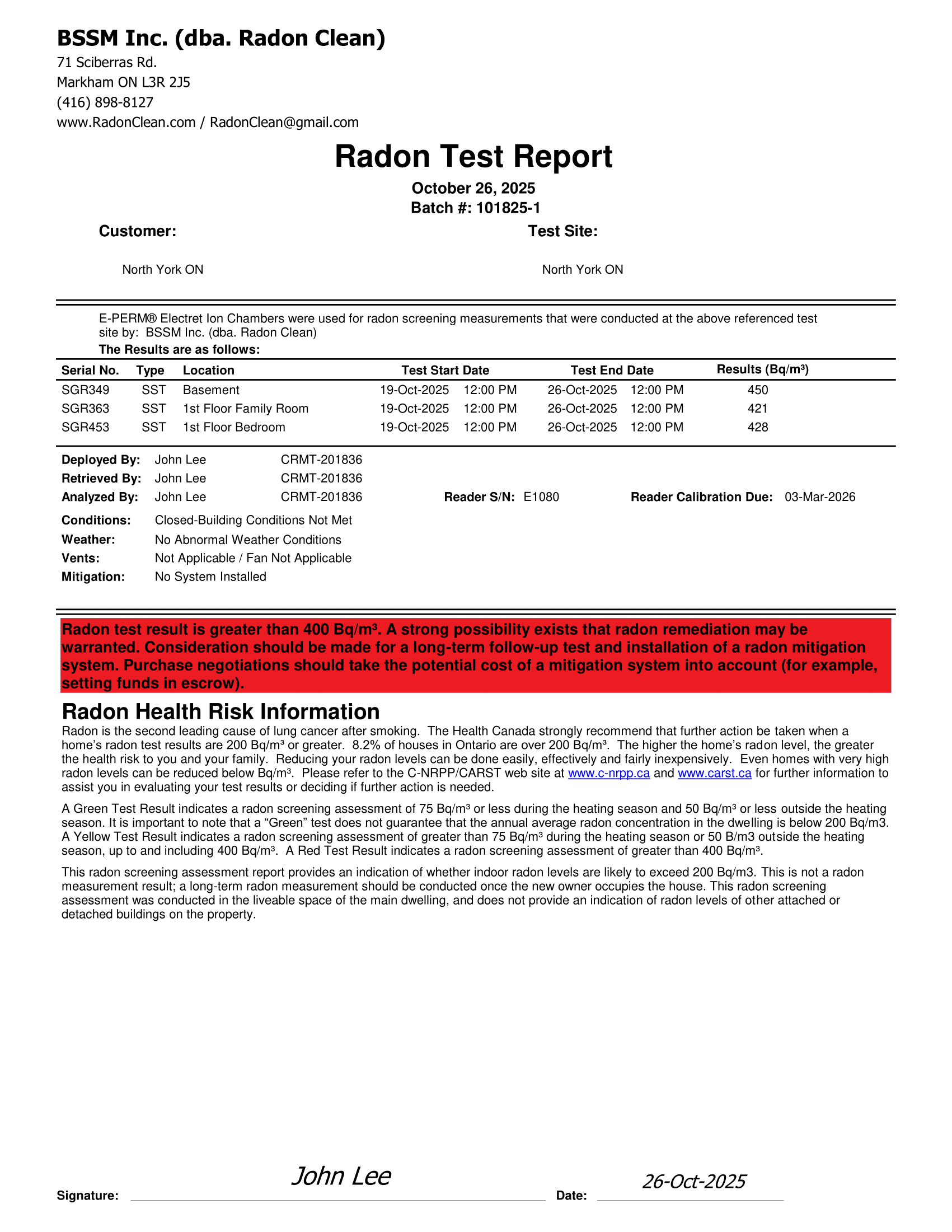
A Sample Red Letter or RADON Test Report is an official document that summarizes the results of a professional RADON screening assessment. It is typically issued by a certified tester such as Radon Clean using devices like the E-PERM® Electret Ion Chamber.
It includes key details such as:
- Test location and duration (start and end dates)
- Measurement devices used
- RADON levels measured (in Bq/m³)
- Weather and testing conditions
- Professional analysis and recommendations
To make it easy to interpret, results are color-coded : 🟨 Red
- High RADON levels (> 400 Bq/m³)
- Immediate mitigation action is strongly advised
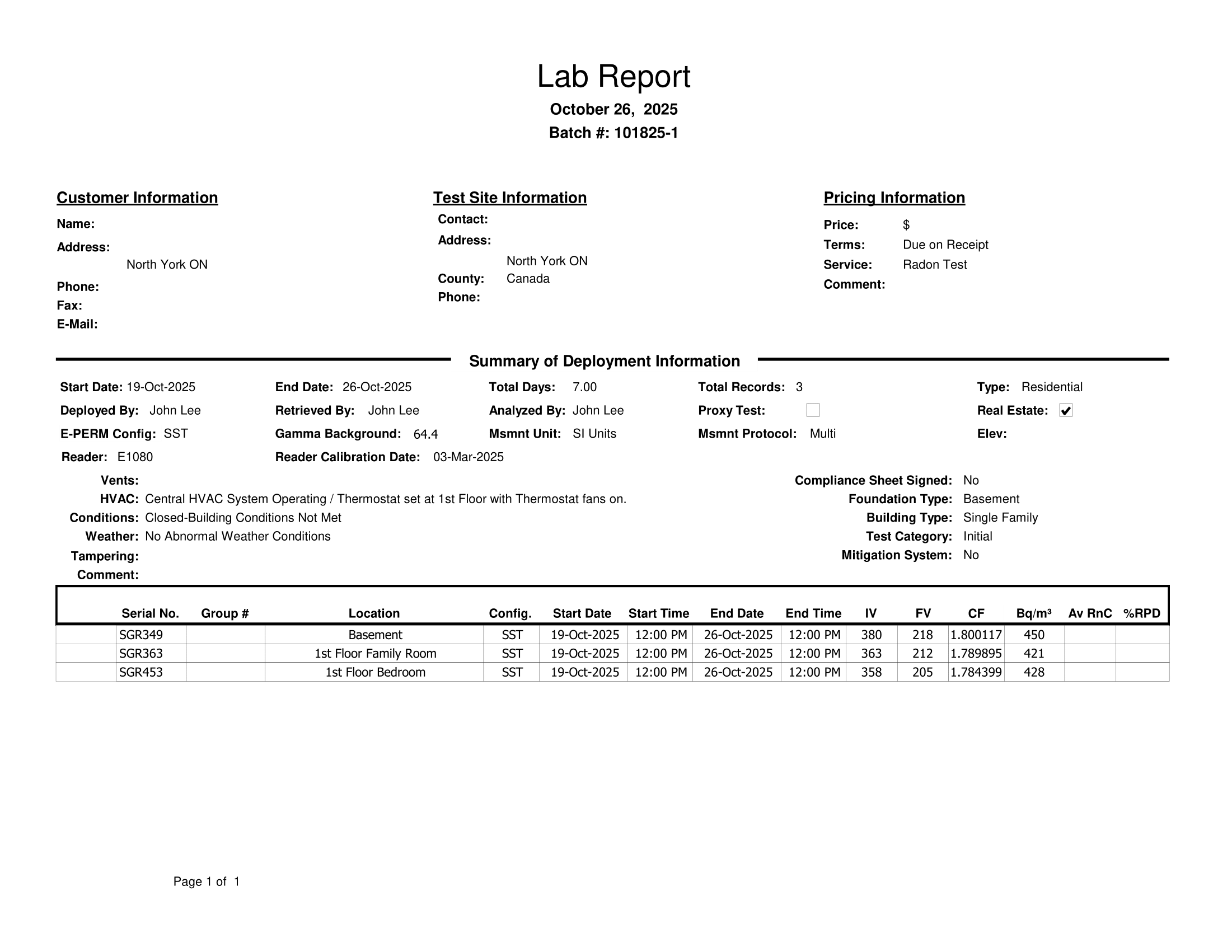
A Sample Lab Report shows how professional RADON test results are presented after laboratory analysis.
It summarizes key information such as:
- Test Location & Duration (e.g., basement, 1st floor, start and end dates)
- Measurement Device Used (E-PERM® Electret Ion Chamber)
- RADON Levels Measured (in Bq/m³ for each location)
- Weather & Testing Conditions (e.g., closed-building status)
- Building Type & Foundation (e.g., single-family, basement)
- Professional Details (tester name, calibration date, and certification)
Each section helps homeowners understand the test’s accuracy and context. A well-documented report ensures transparency and supports informed decisions about whether mitigation is needed.
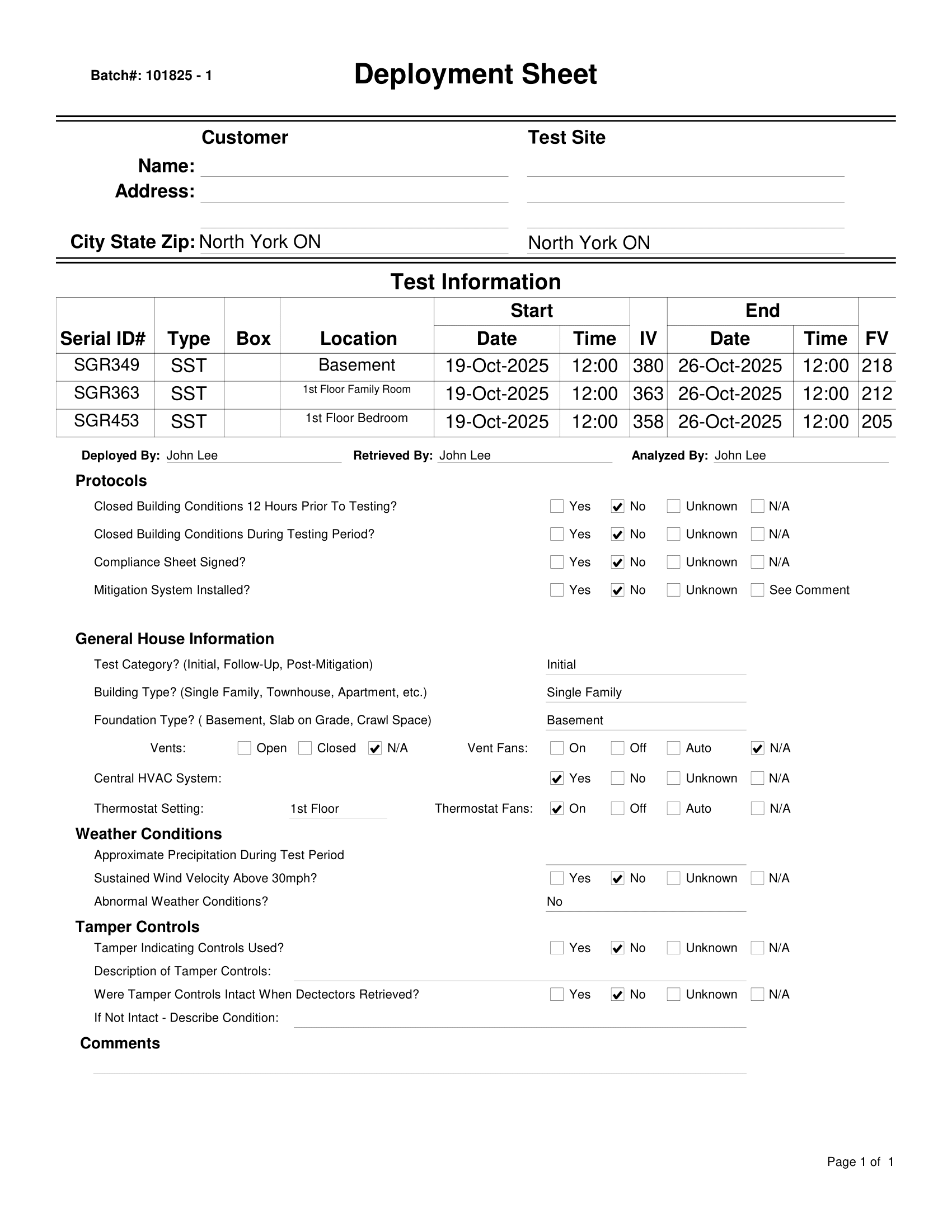
A Sample Deployment Sheet is a record of how and where the RADON test devices were placed during the testing period.
It provides all field details before laboratory analysis, including:
-
Test Locations & Device Information
(e.g., basement, family room, bedroom, with serial ID numbers and start/end dates) -
Building Conditions
Whether closed-building conditions were maintained and if a mitigation system was present. -
House Details
Type of building, foundation, HVAC operation, and thermostat setting. -
Weather & Tamper Controls
Notes on weather, wind, and whether tamper seals remained intact. -
Technician Information
Who deployed, retrieved, and analyzed the detectors.
This document ensures transparency, showing that the RADON test was conducted under proper conditions for accurate results.
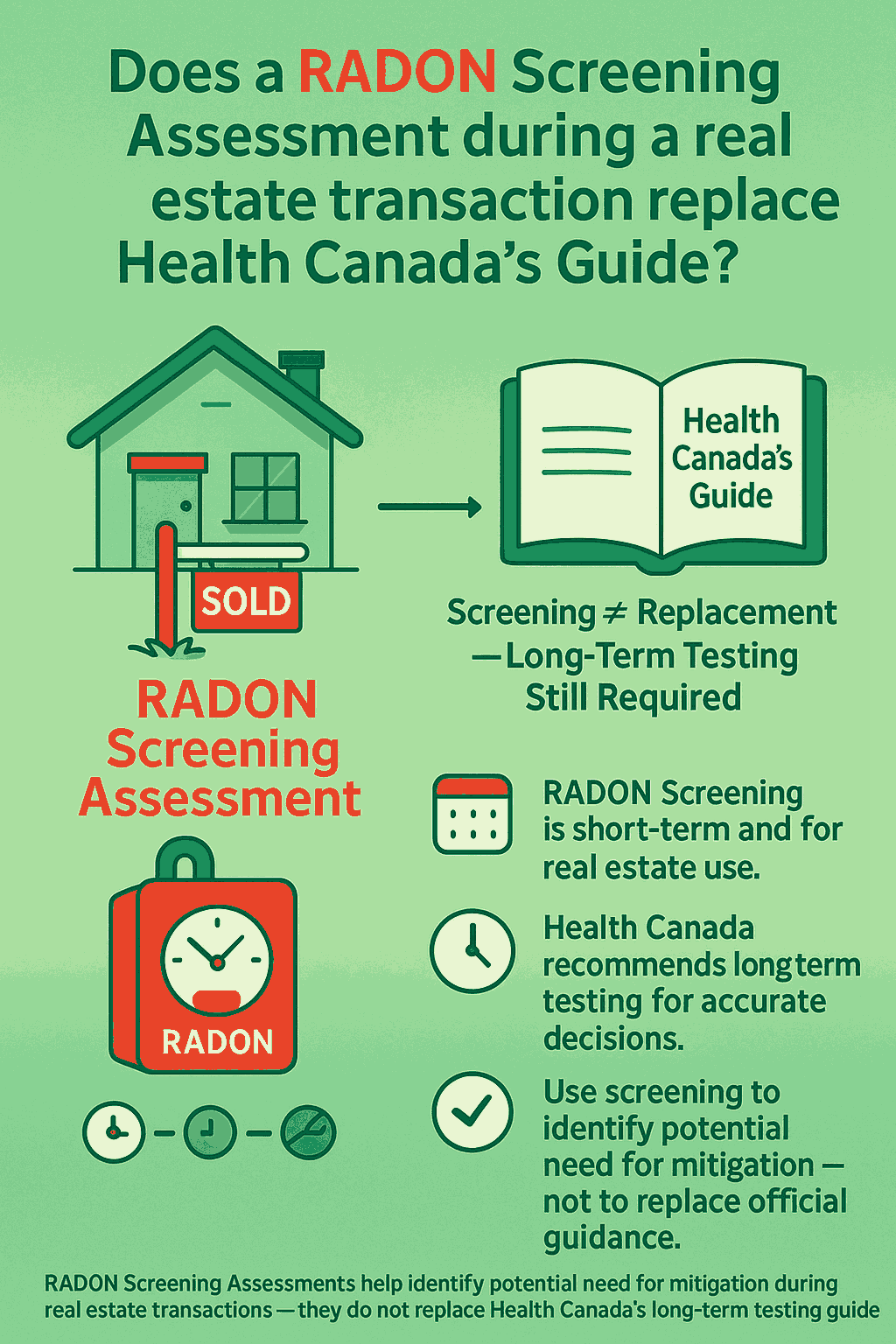
No. A RADON Screening Assessment does not replace Health Canada’s Guide for Radon Measurement in Residential Dwellings (Homes). Health Canada recommends that mitigation decisions be based on long-term RADON measurements, not short-term screening results.
Instead, this guideline offers a consistent method to help determine whether a RADON mitigation system might be needed in a home during a real estate transaction.
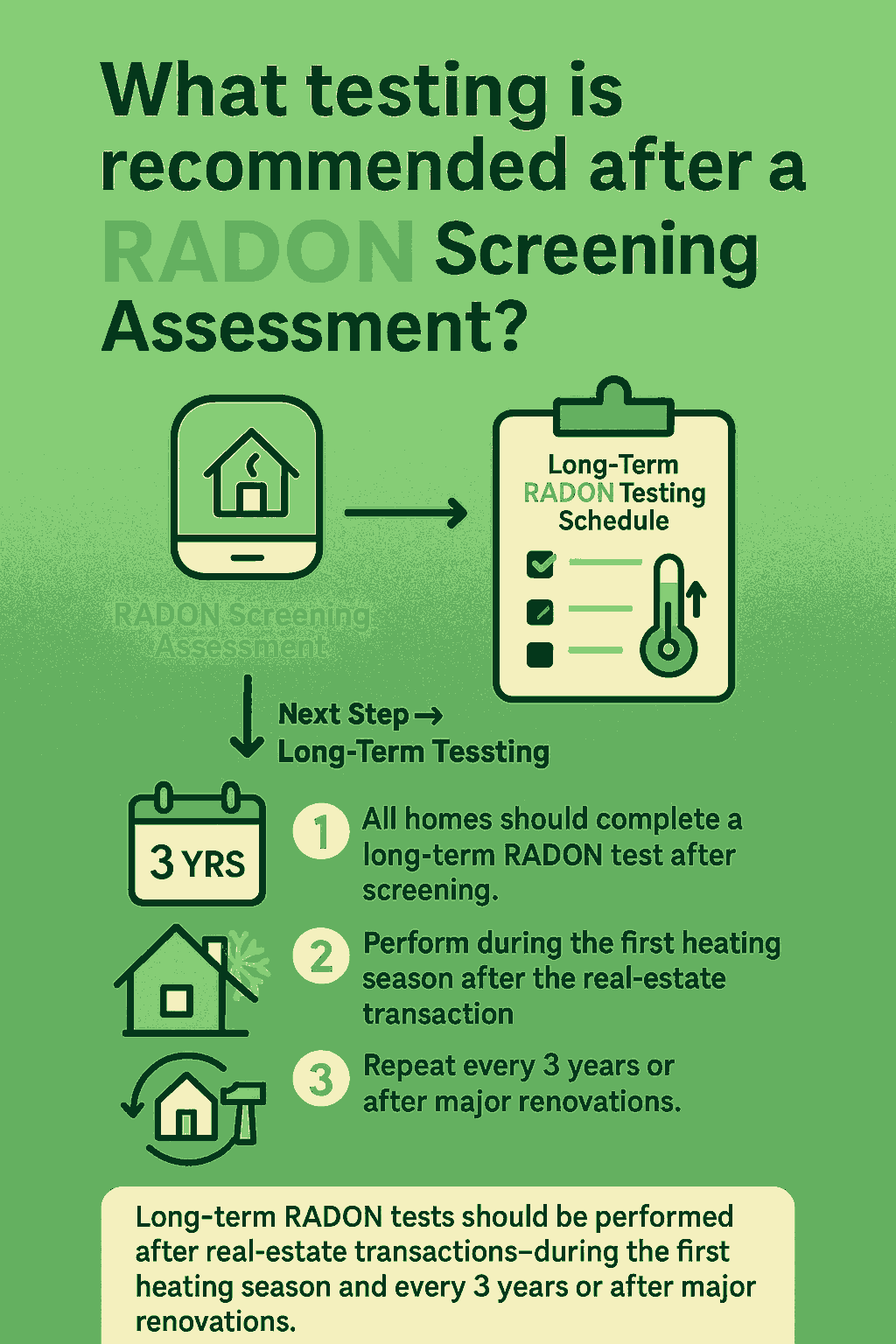
No matter what the RADON Screening result shows - whether green, yellow, or red - a long-term RADON test should be carried out during the first heating season after the real estate transaction.
Follow-up long-term tests are also recommended:
- Every 3 years, and
- After any major renovations to the home.
This ensures accurate monitoring of RADON levels over time and helps maintain a safe indoor environment.
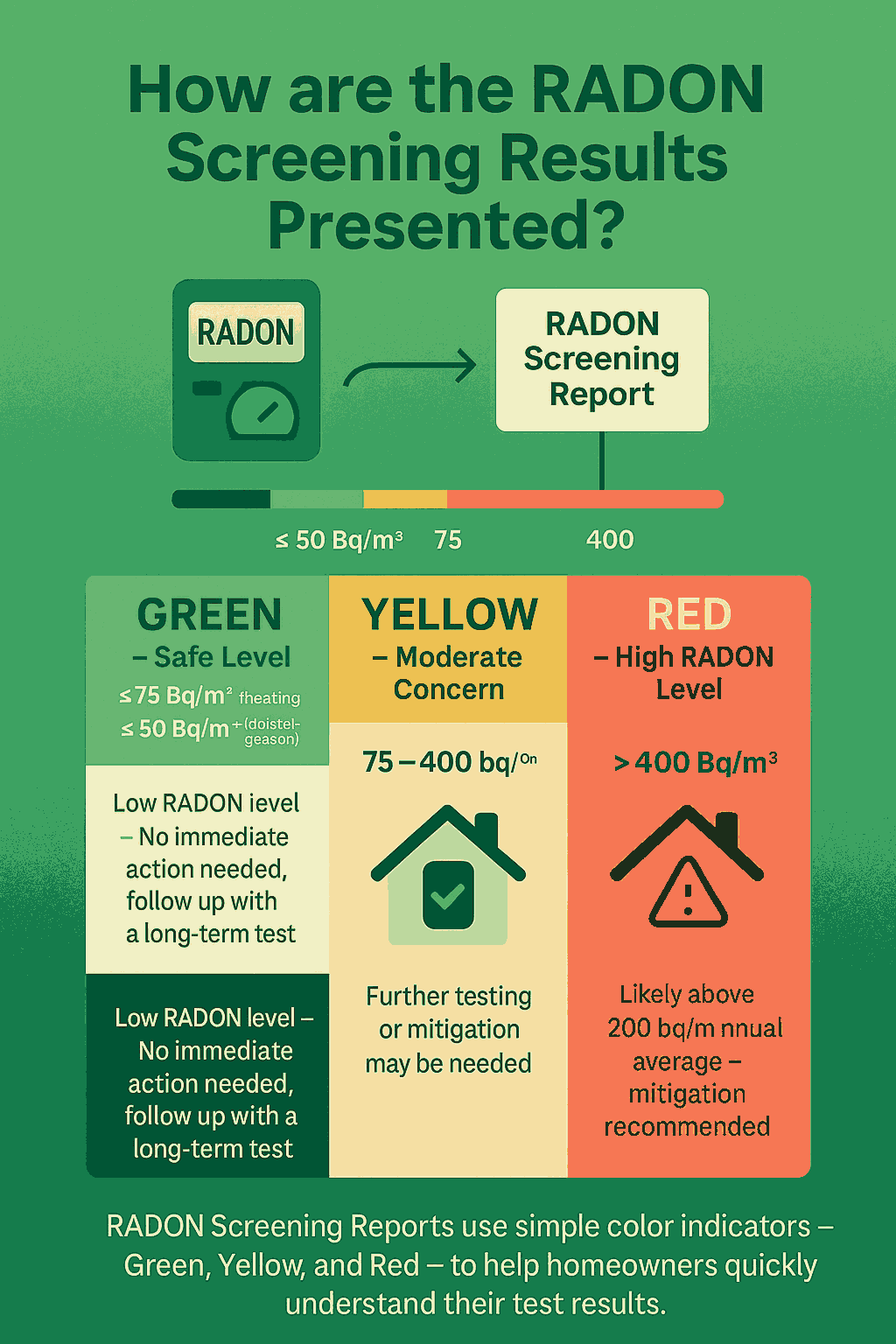
The results are shown in a RADON Screening Report using an easy color indicator system - Green, Yellow, or Red - to help you understand the risk level at a glance:
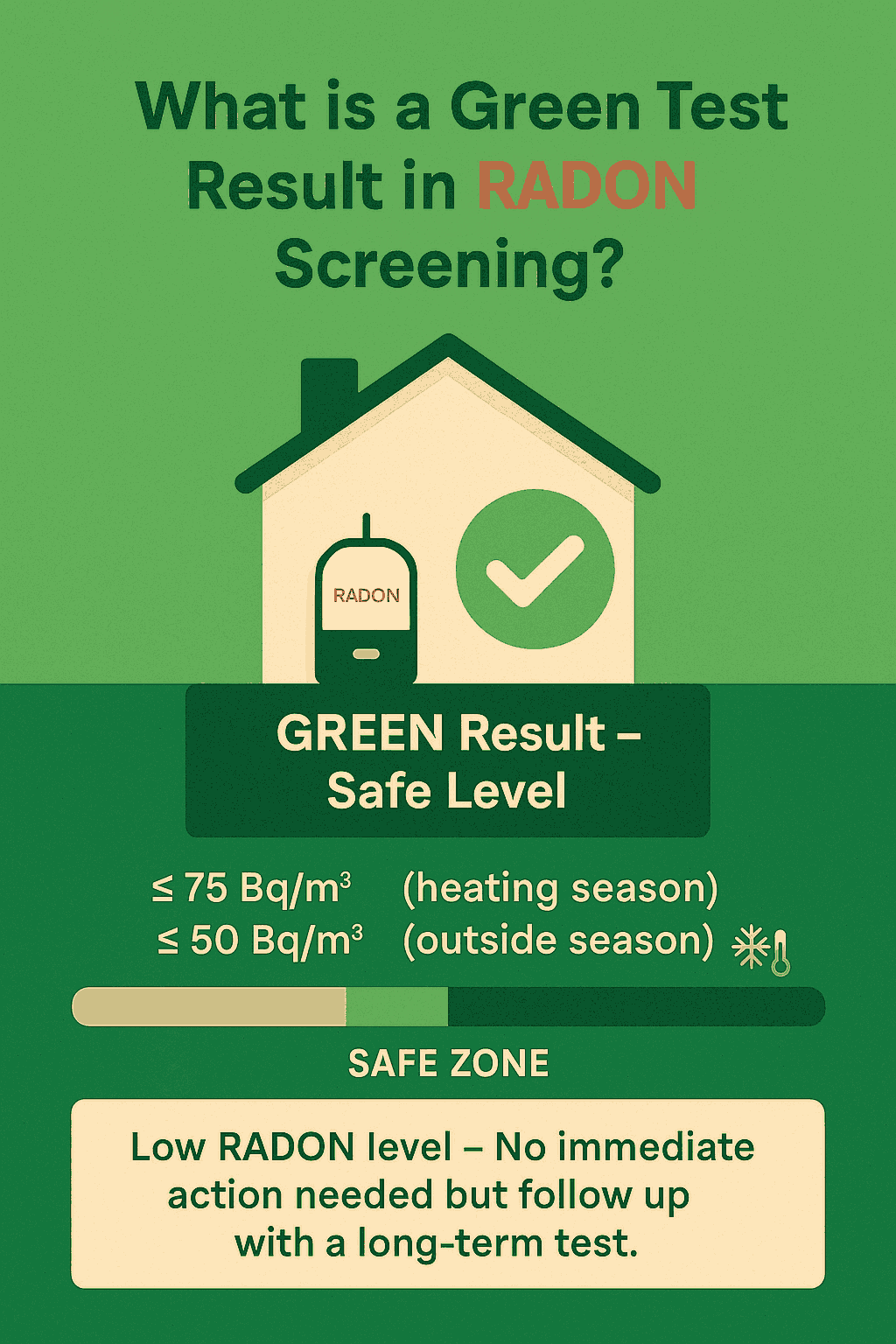
🟩 Green Result → RADON level ≤ 75 Bq/m³ (heating season) or ≤ 50 Bq/m³ (outside heating season).
→ No immediate action needed, but a long-term follow-up test is advised.
🟨 Yellow Result → RADON level between 75 – 400 Bq/m³.
→ Indicates moderate concern; further testing or mitigation may be needed.
🟥 Red Result → RADON level > 400 Bq/m³.
→ Suggests a strong likelihood that the annual average exceeds 200 Bq/m³ - mitigation is recommended.
A Green Test Result means your RADON level is low and safe.
It indicates a reading of 75 Bq/m³ or less during the heating season,
and 50 Bq/m³ or less outside the heating season.
No immediate action is needed, but a long-term follow-up RADON test is recommended to confirm stability over time.
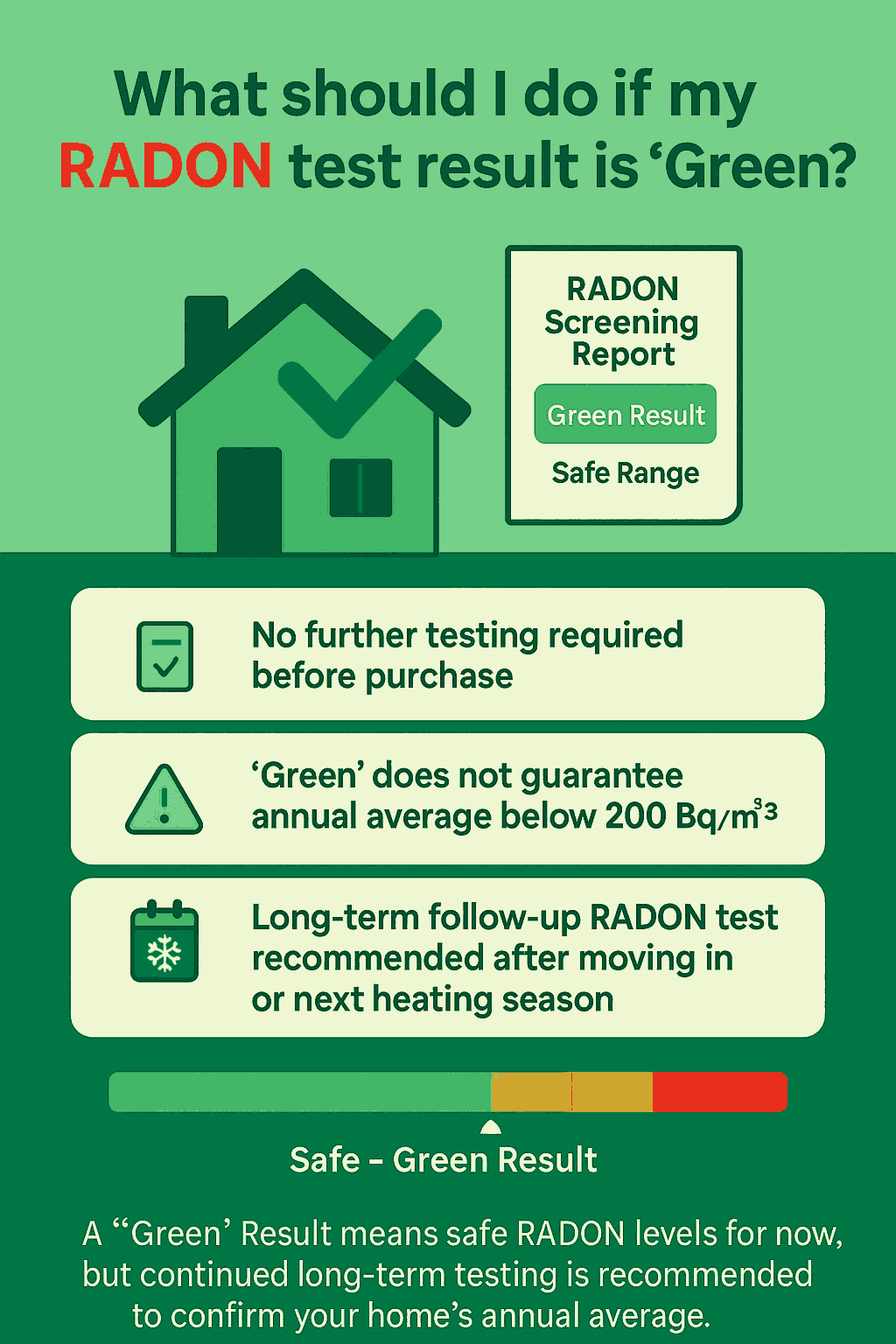
A Green Test Result means your RADON Screening Report is in the safe range, and no further testing is required before purchase.
However, it’s important to understand that a “Green” result does not guarantee that your home’s annual average RADON level is below 200 Bq/m³.
To be certain, a long-term follow-up RADON test is still recommended after moving in or during the next heating season.
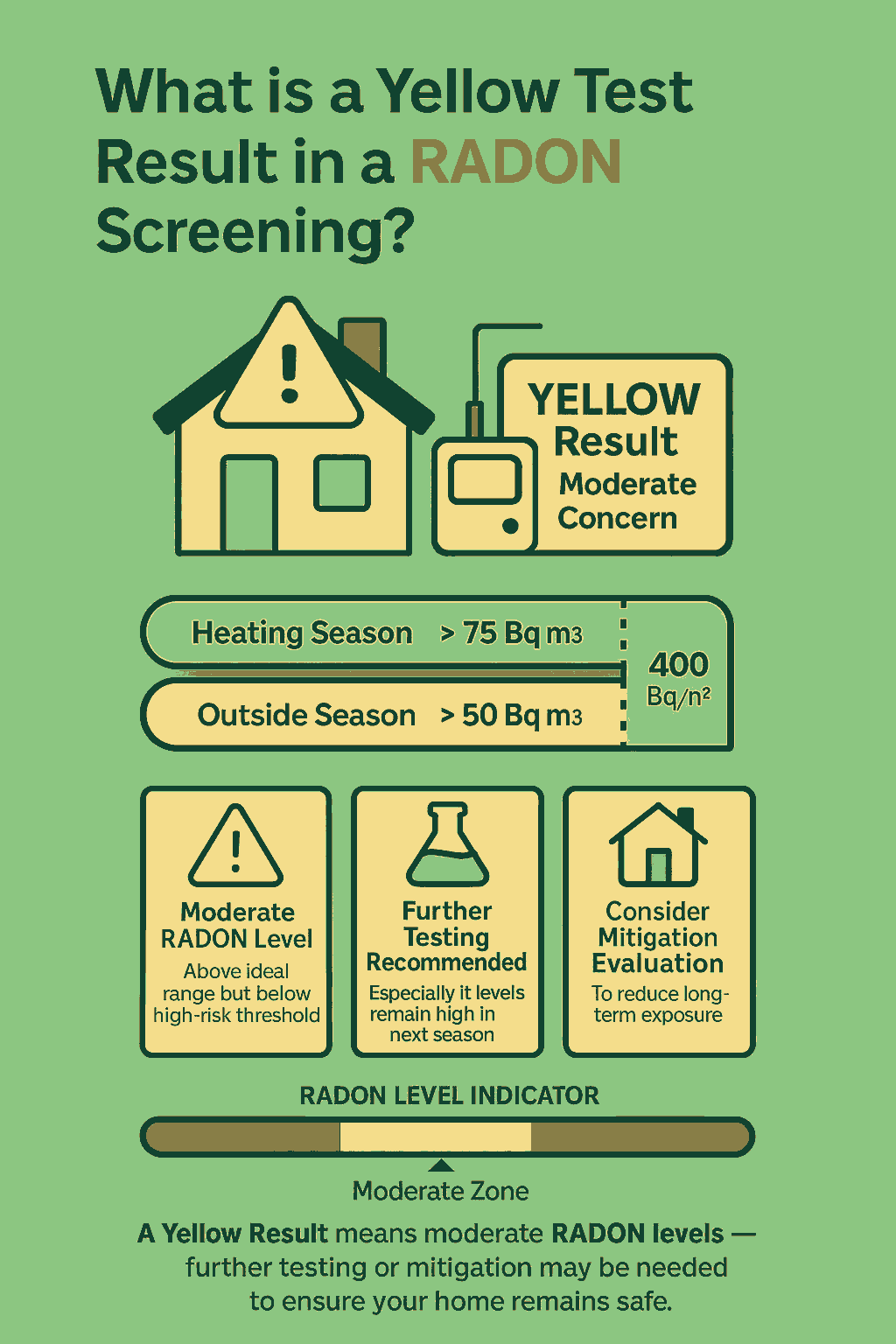
A Yellow Test Result means your home’s RADON level is moderate - higher than ideal but not yet critical.
It indicates a reading of more than 75 Bq/m³ during the heating season, or more than 50 Bq/m³ outside the heating season, up to and including 400 Bq/m³.
his result suggests that further testing or possible mitigation may be needed to ensure your home stays safe long-term.
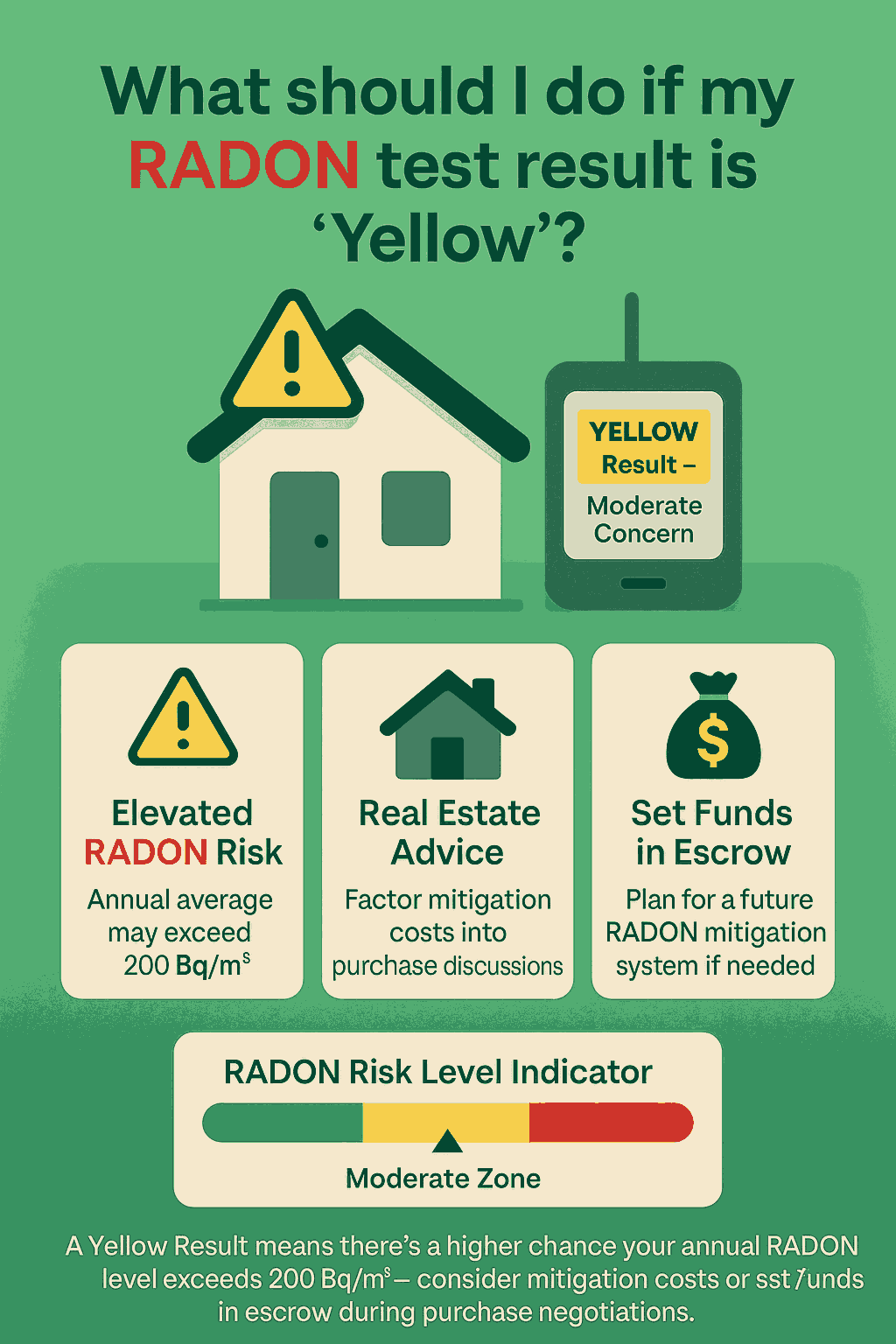
A Yellow Test Result means your home’s RADON level is moderately elevated, and there’s a higher chance that the annual average exceeds 200 Bq/m³.
When buying or selling a home, it’s wise to consider the potential cost of installing a RADON mitigation system.
In real estate transactions, this can be addressed by including funds in escrow or negotiating for future mitigation work.
A “Red” result means the measured RADON level is above 400 Bq/m³, showing a strong likelihood that your home’s annual average RADON concentration is well above the Health Canada guideline of 200 Bq/m³.
Immediate mitigation action is strongly recommended to reduce RADON levels and protect indoor air quality.
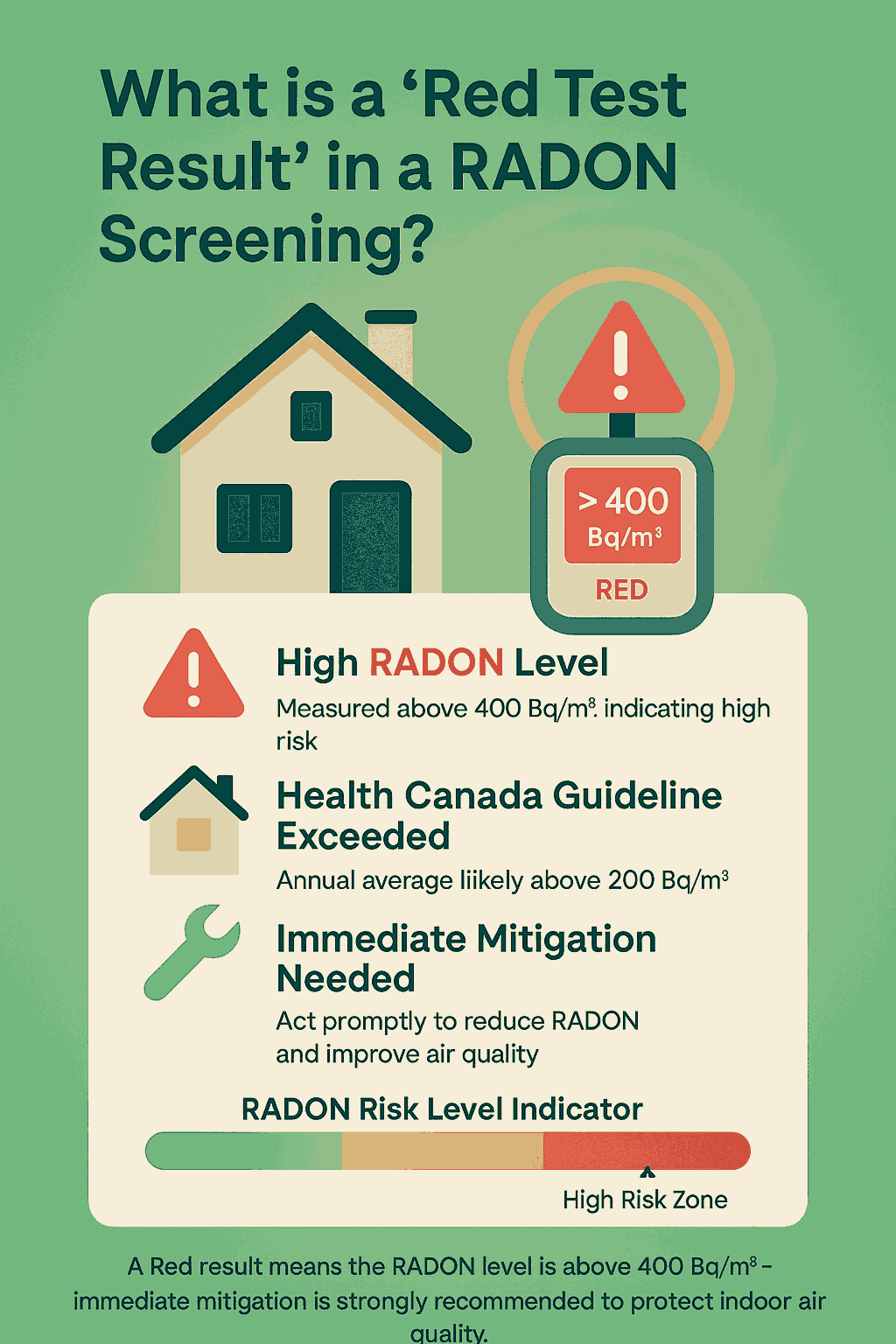
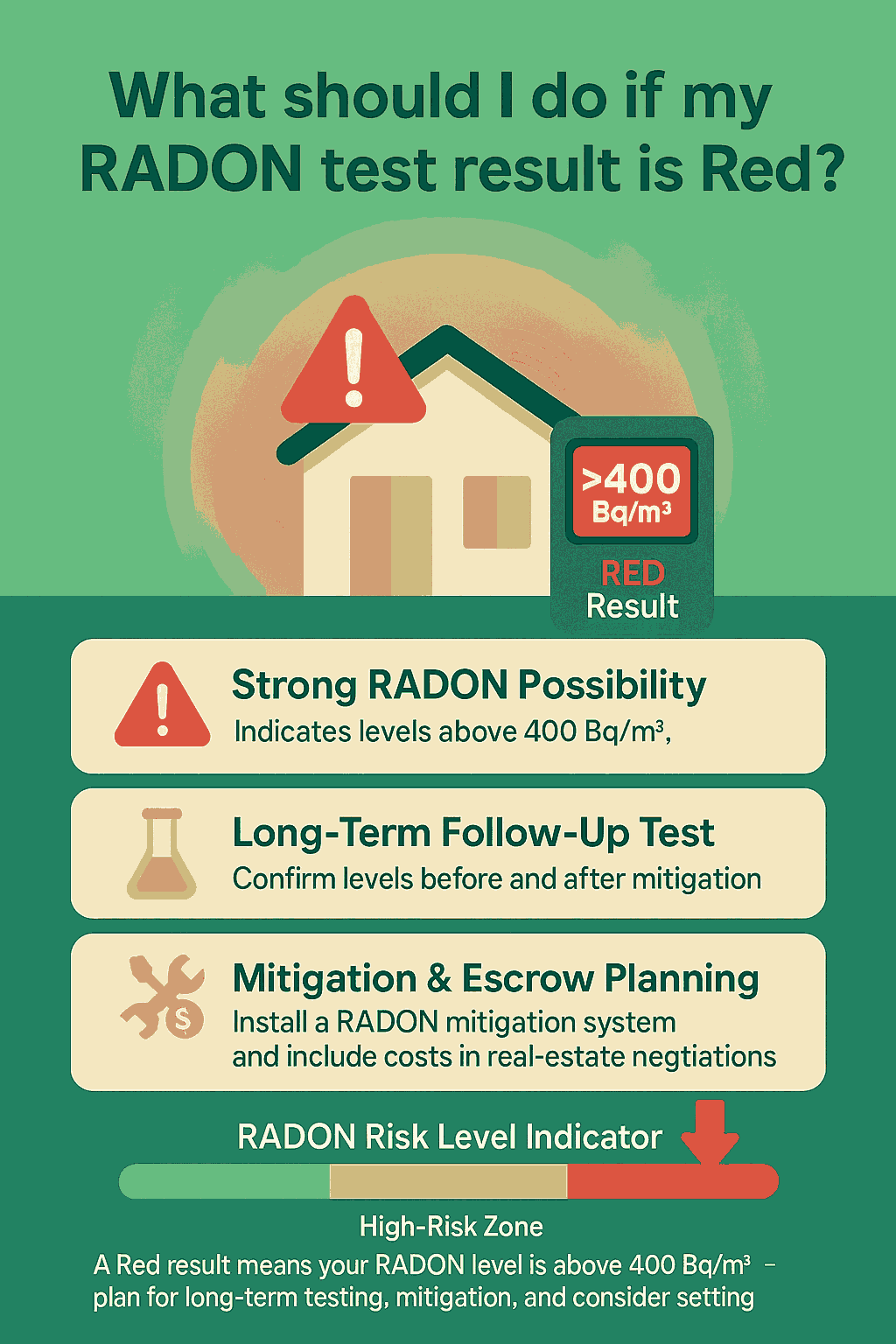
A “Red” result means your screening level is above 400 Bq/m³, which strongly suggests that radon remediation is needed.
You should plan for a long-term follow-up test and consider installing a RADON mitigation system as soon as possible.
If you are buying or selling a home, be sure to include the potential cost of mitigation in your negotiations - for example, by setting funds in escrow until remediation is completed.
“Anti-Interference Measures” are precautions taken to ensure accurate RADON test results while the test device is left unattended during the assessment period.
These measures help prevent accidental or intentional tampering and maintain proper testing conditions.
Common examples include:
- Sealing or securing the device so it cannot be moved or opened.
- Posting warning signs such as “Do not disturb – Test in progress.”
- Explaining test conditions to occupants, like keeping doors and windows closed.
- Using tamper-detection features on advanced digital monitors.
- Professional setup and retrieval by certified RADON technicians.
These practices ensure the test is conducted correctly and that the final report reflects trustworthy and accurate RADON results.
.png)
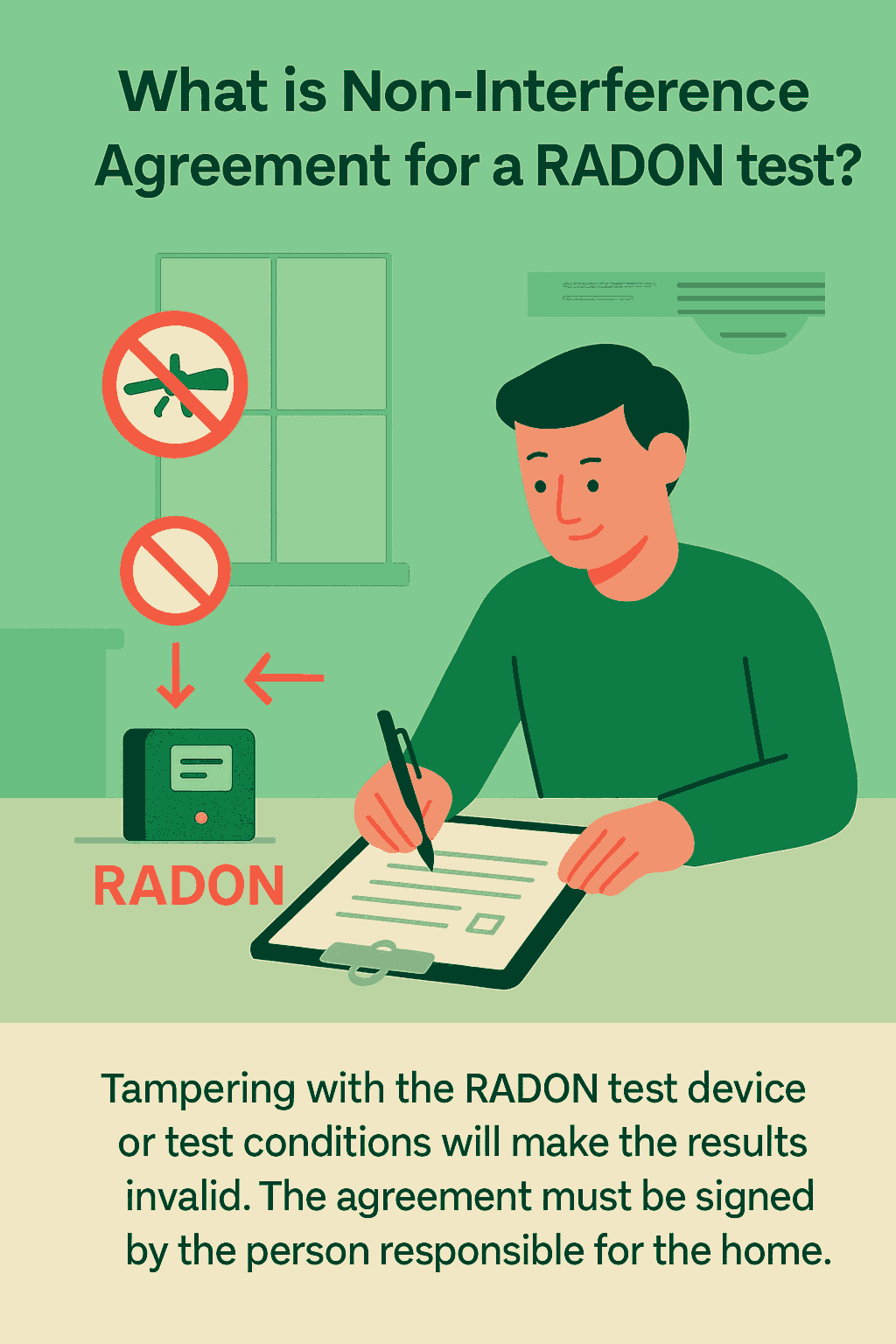
Before starting a professional RADON test, a Non-Interference Agreement must be signed. This document confirms that the homeowner or occupant will not disturb or alter the test conditions in any way.
Any violation of the agreement - such as moving the device, opening windows, or changing ventilation - will make the test results invalid. The form must be signed by a responsible person who has care, custody, and control of the home.
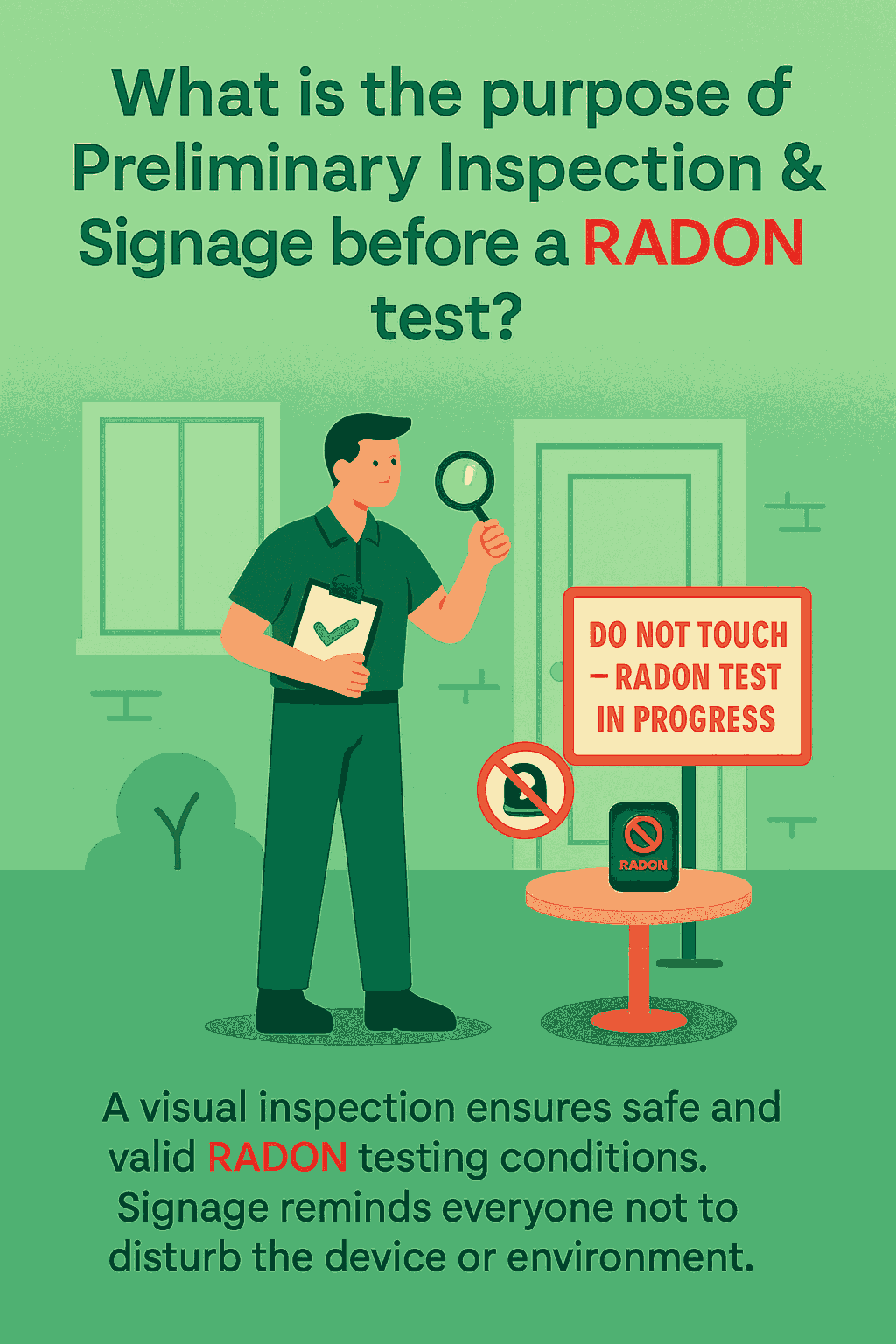
Before starting a RADON test, a visual inspection of the home must be done to check that testing conditions are suitable and safe.
Clear signage is then placed in the home, informing occupants not to disturb the test device or conditions.
These steps follow the C-NRPP/CARST Guideline for Conducting Radon Assessments and Short-Term Radon Measurements to ensure accurate and valid results.