FAQ :About Mitigations General
This section covers General Information About RADON Mitigation, including how mitigation systems work, why they are needed, and the expected results after installation.
You’ll learn about the basic principles behind RADON reduction, common system components, and how professional design and installation ensure long-term effectiveness.
These FAQs provide a solid understanding of how RADON mitigation protects your home, improves indoor air quality, and helps create a healthier living environment for you and your family.
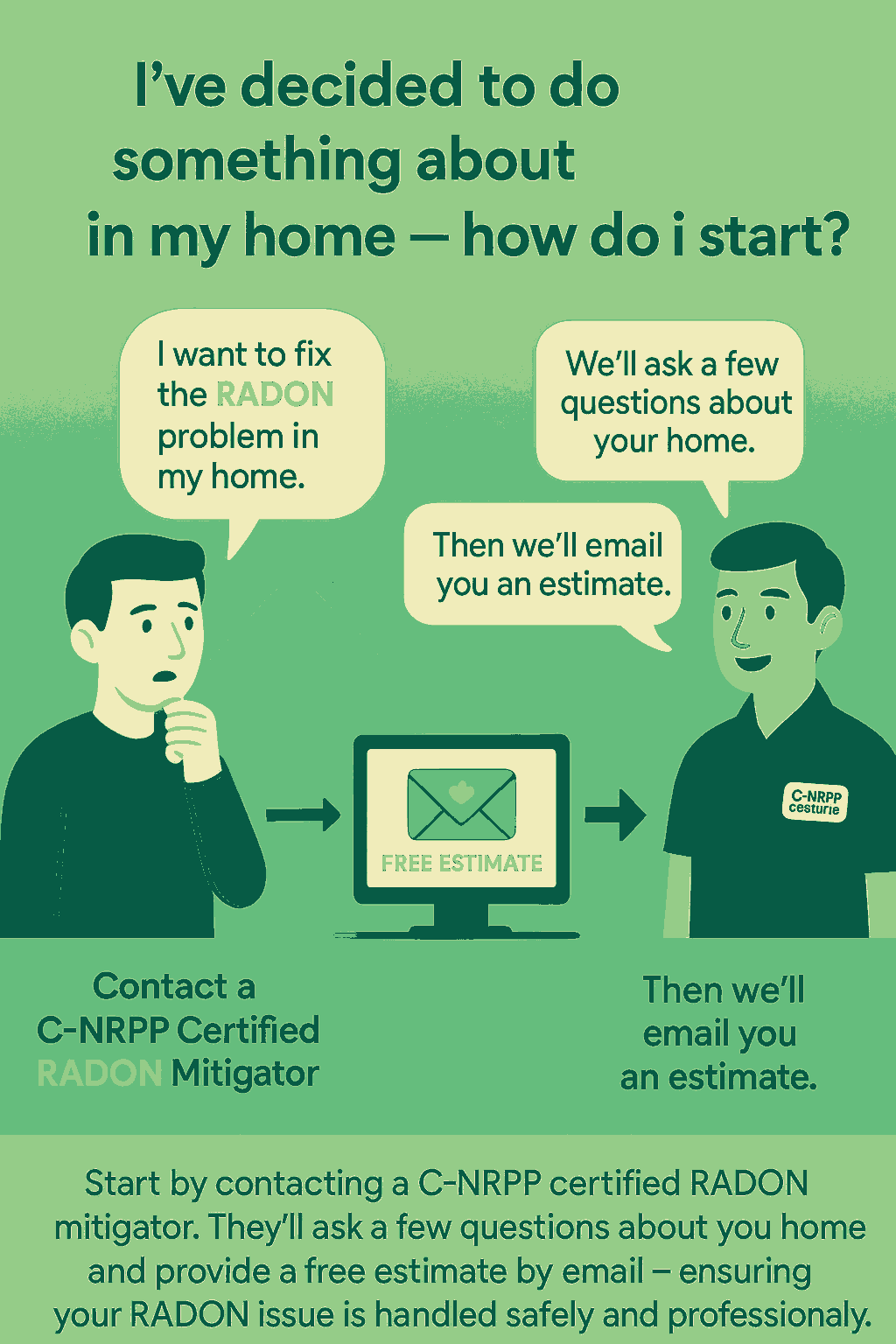
The first step is to contact a C-NRPP certified RADON mitigator to ensure your system is designed and installed by qualified professionals.
Certified mitigators are experienced, insured, bonded, and accredited to handle RADON safely and effectively.
When you reach out to us, we’ll:
- Ask a few questions about your home.
- Provide a free estimate by email based on your specific situation.
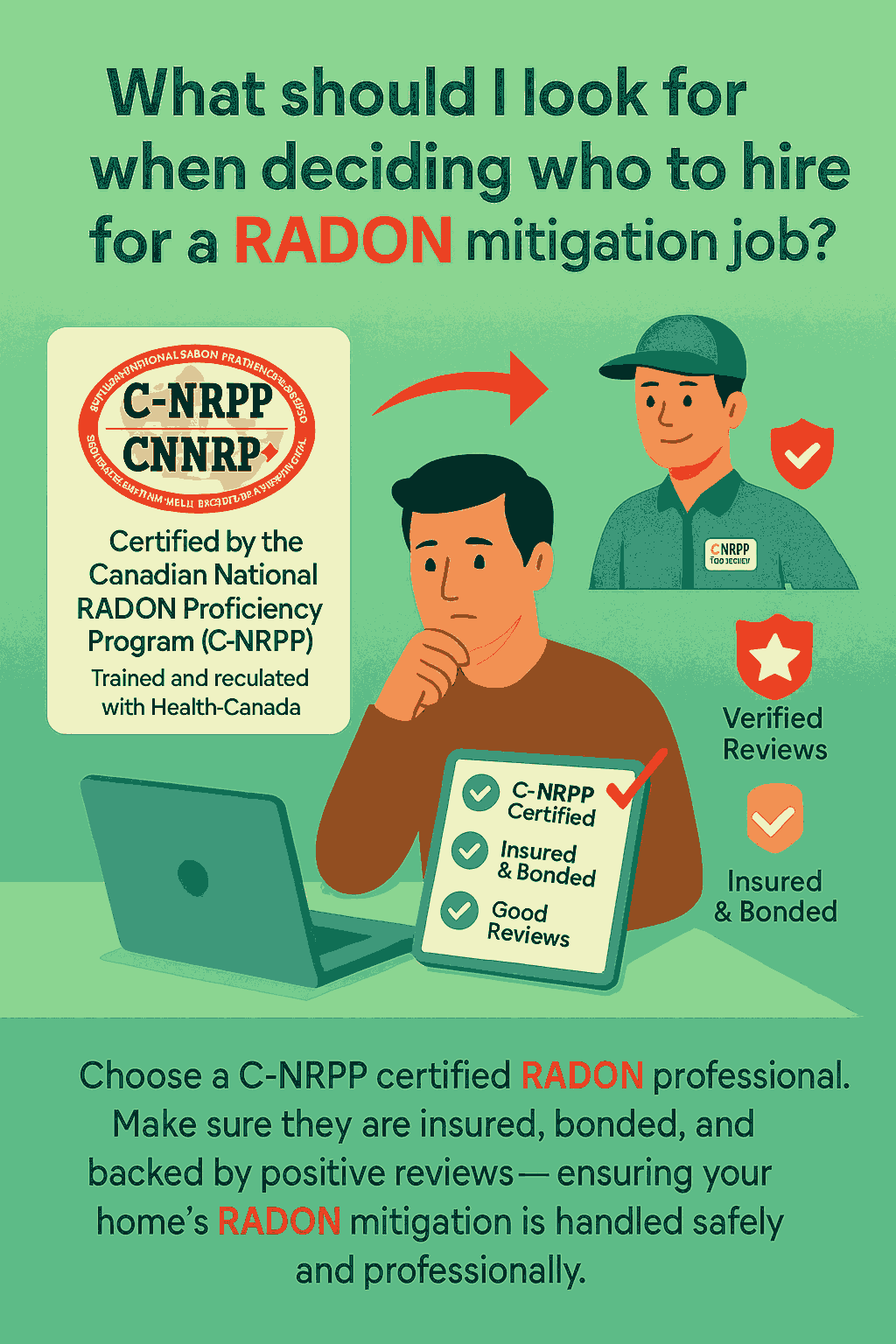
Always choose a C-NRPP Certified RADON Professional - the national body working with Health Canada to train, educate, and certify RADON experts in Canada.
Also make sure they are insured, bonded, and have positive online reviews to ensure you're hiring a qualified and experienced professional.
🛠️ Look for this logo when hiring:
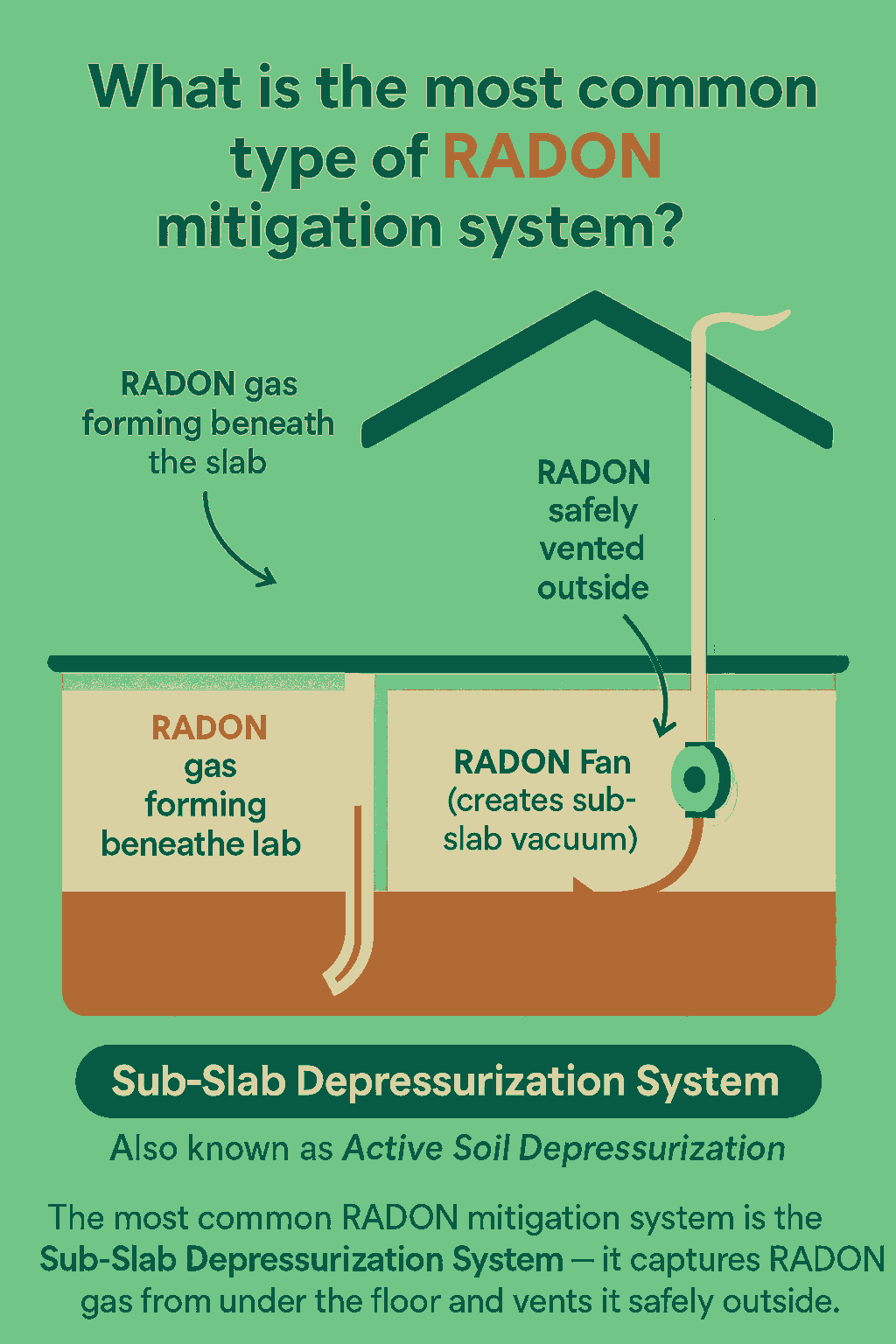
The most common system is called a Sub-Slab Depressurization System, also known as Active Soil Depressurization.
It works by capturing RADON gas from beneath the floor - where it forms - and venting it safely outside, keeping indoor air clean and safe.
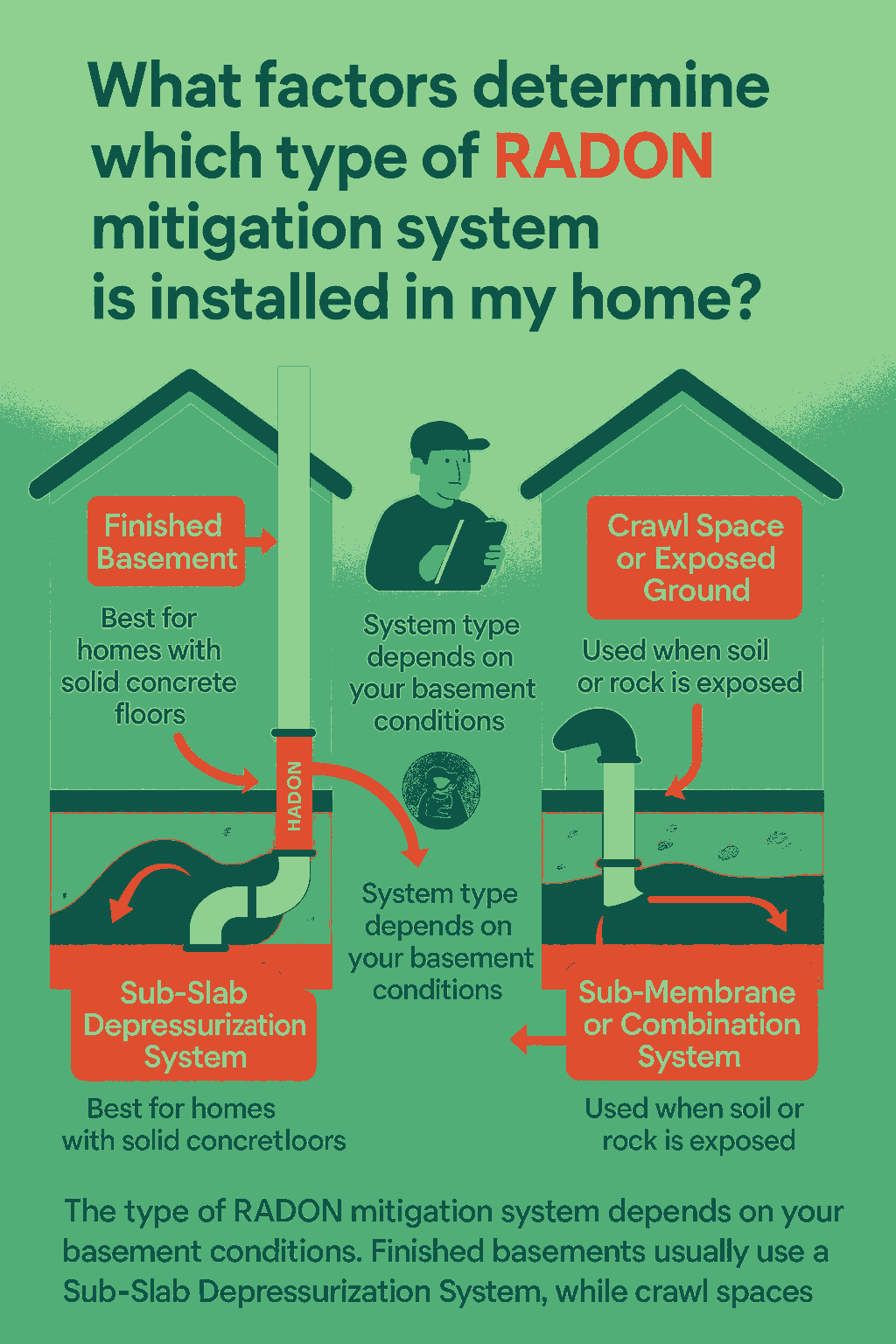
The main factor is your basement type.
- If you have a finished basement, the most common option is a Sub-Slab Depressurization System.
- If your home has crawl spaces, exposed dirt, or exposed rock, then a different or combined system may be needed to effectively remove RADON.
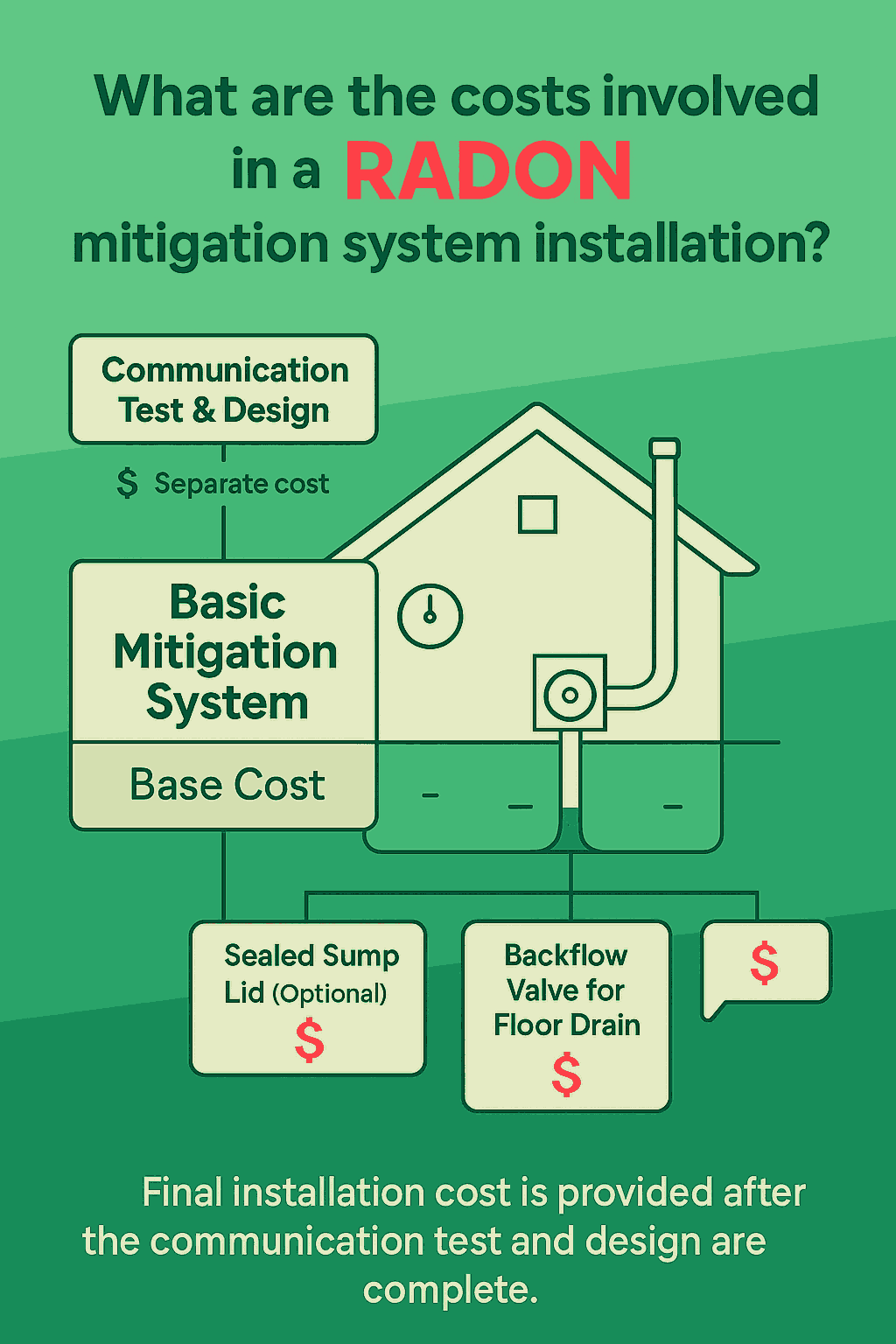
The communication test and system design are separate from the installation cost. After completing the test and design, we’ll provide an exact installation quote based on your home’s layout.
We start with a basic mitigation system price, then adjust as needed for your home - for example, if you need a sealed sump lid, backflow valves for floor drains, or extra suction points. The total cost also depends on how many suction points and fans are required, and the type of fan installed for optimal performance.
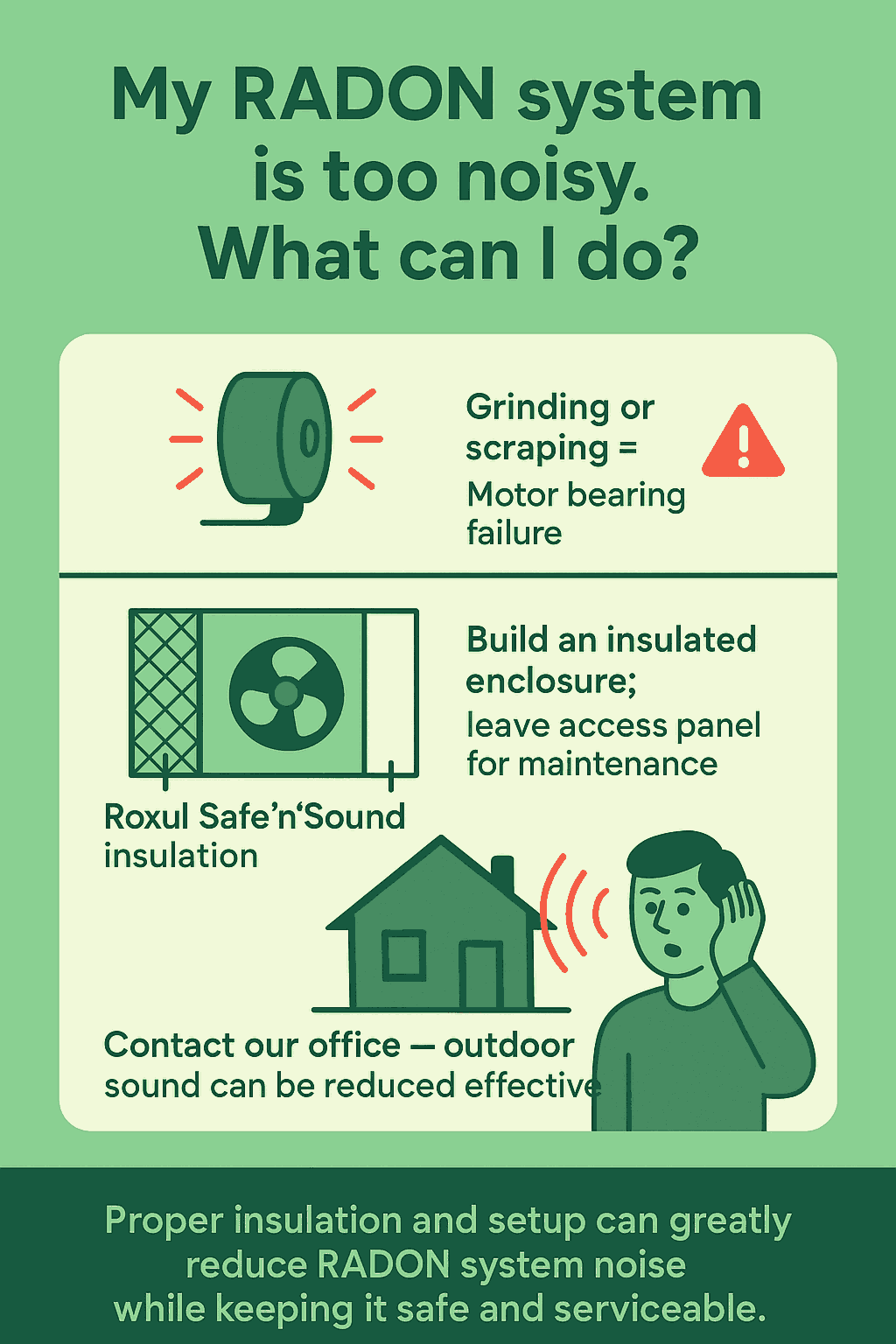
If the fan sounds like it’s grinding or scraping, the motor bearings may have failed - please contact us to schedule a service call.
If the fan isn’t damaged but still feels too loud, you can reduce the noise by building an insulated enclosure around it.
Use Roxul Safe’n’Sound insulation and drywall, but leave an access point in case the fan needs service.
If the outdoor noise is the main concern, contact our office - there are several ways we can help significantly reduce the sound.
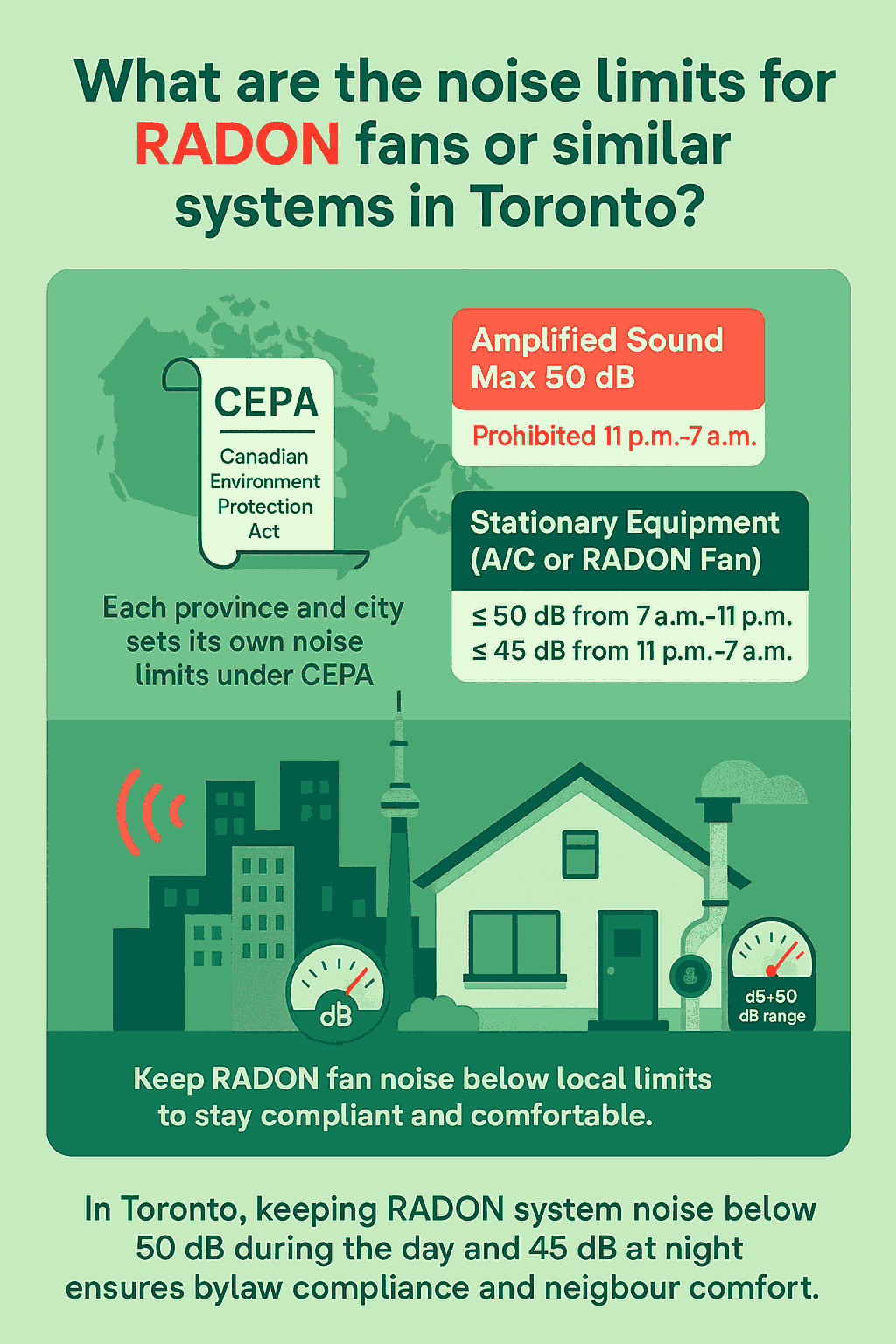
Noise in Canada is regulated under the Canadian Environmental Protection Act (CEPA), which requires each province and city to set its own noise limits.
In Toronto, noise levels are defined by the City of Toronto’s Municipal Code:
- Amplified Sound: Must not exceed 50 dB, and no amplified sound is allowed between 11 p.m. and 7 a.m.
-
Stationary Equipment (like air conditioners or RADON fans):
- Maximum 50 dB from 7 a.m. to 11 p.m.
- Maximum 45 dB from 11 p.m. to 7 a.m.
Keeping your system within these limits helps maintain comfort and comply with local noise bylaws.
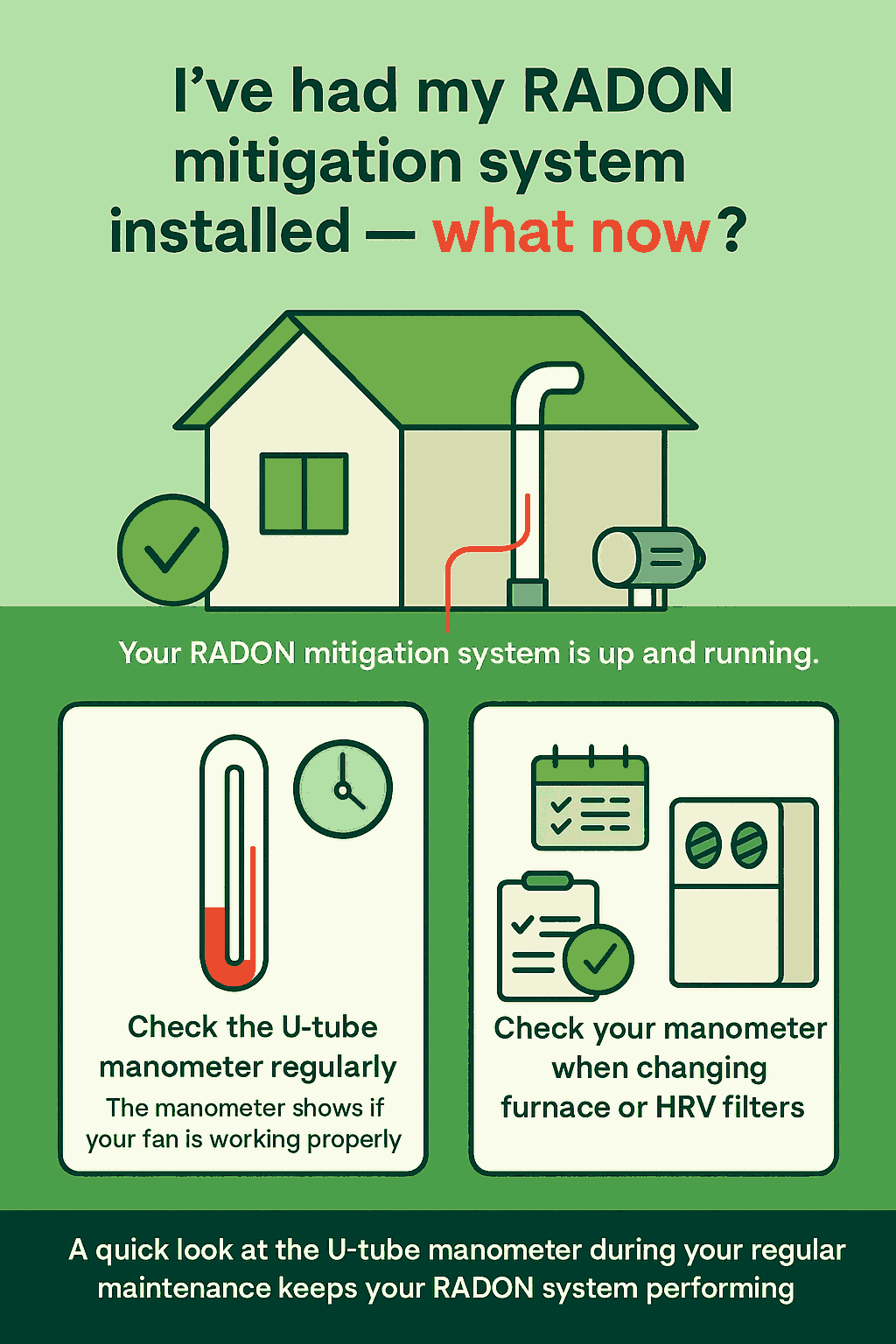
Congratulations! Your Sub-Slab Depressurization (SSD) system requires very little maintenance
Just check the U-tube manometer regularly - it’s mounted on the suction side of the pipe and shows if the fan is working properly.
We recommend checking it during your routine home maintenance, such as when you change your furnace or HRV filters.
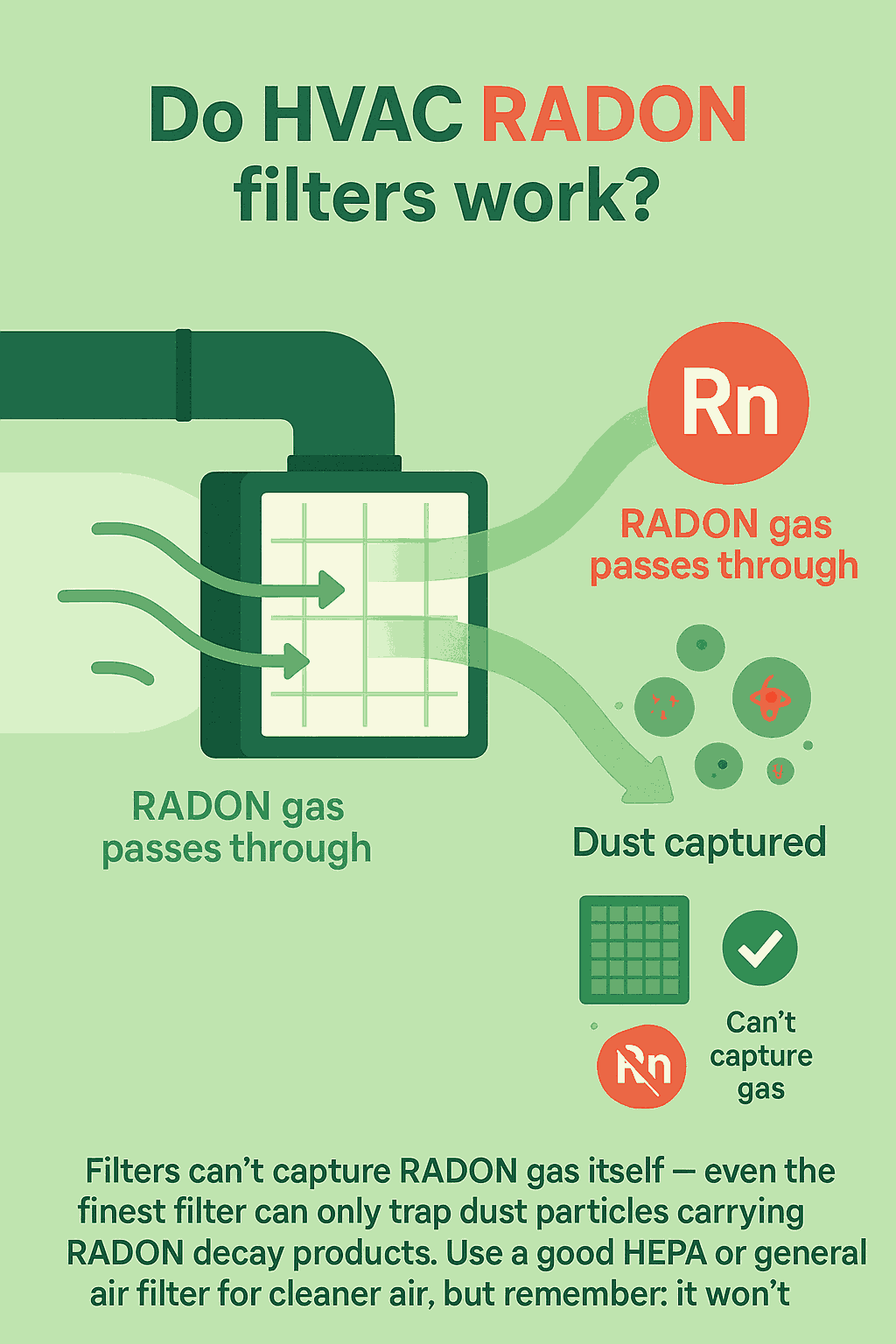
No - filters can’t capture RADON gas itself, no matter how fine they are or what method they use.
What filters like HEPA can do is reduce dust particles that may hold radioactive decay products from RADON, helping keep them out of the air and your lungs.
A RADON-specific filter isn’t required - a good general air filter is enough for that purpose.
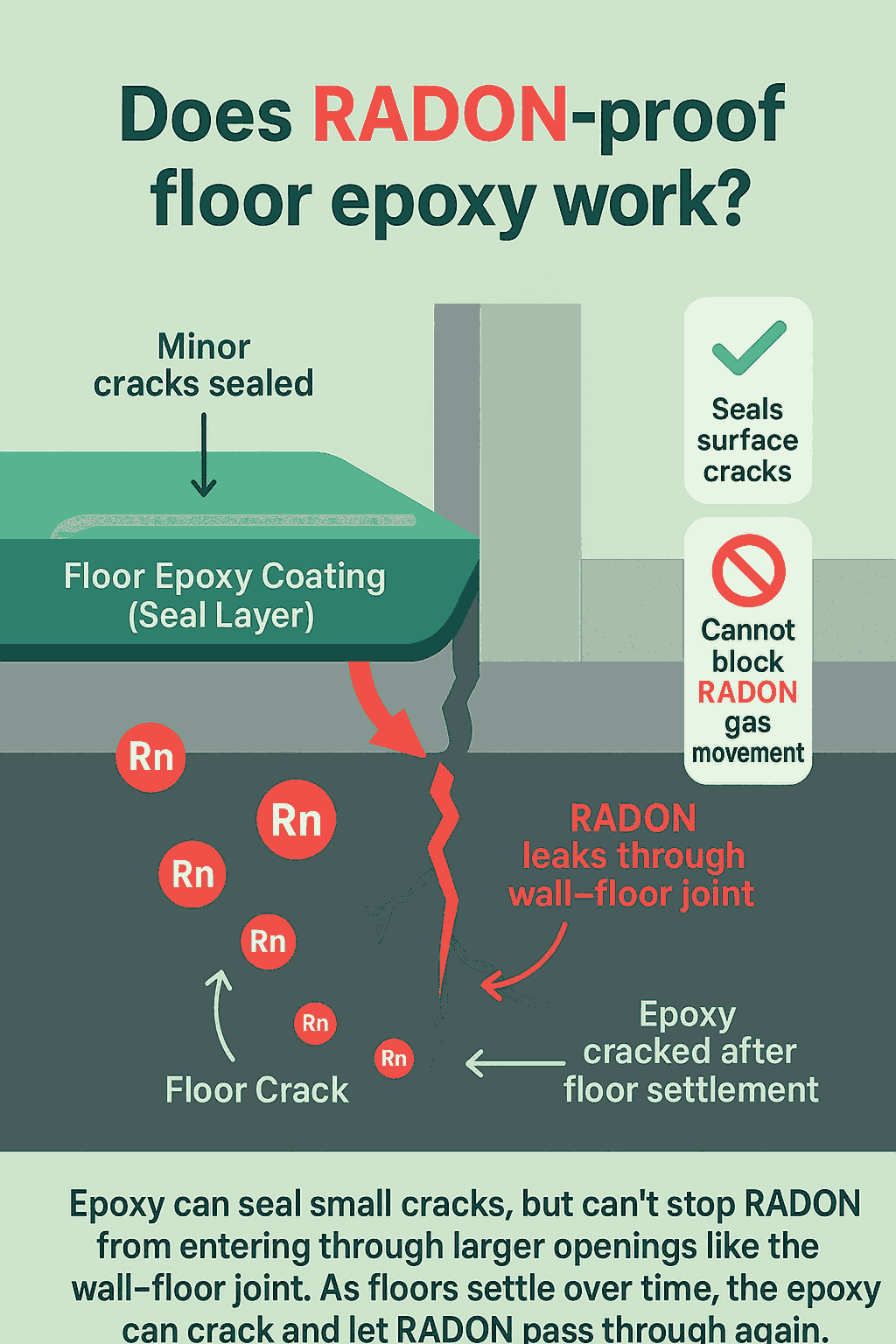
Epoxy coatings can help seal small cracks in the floor, but they can’t stop RADON from entering through larger openings - especially the wall–floor joint, which is the main entry path. If the floor moves or settles, the epoxy can crack, letting RADON gas pass through again
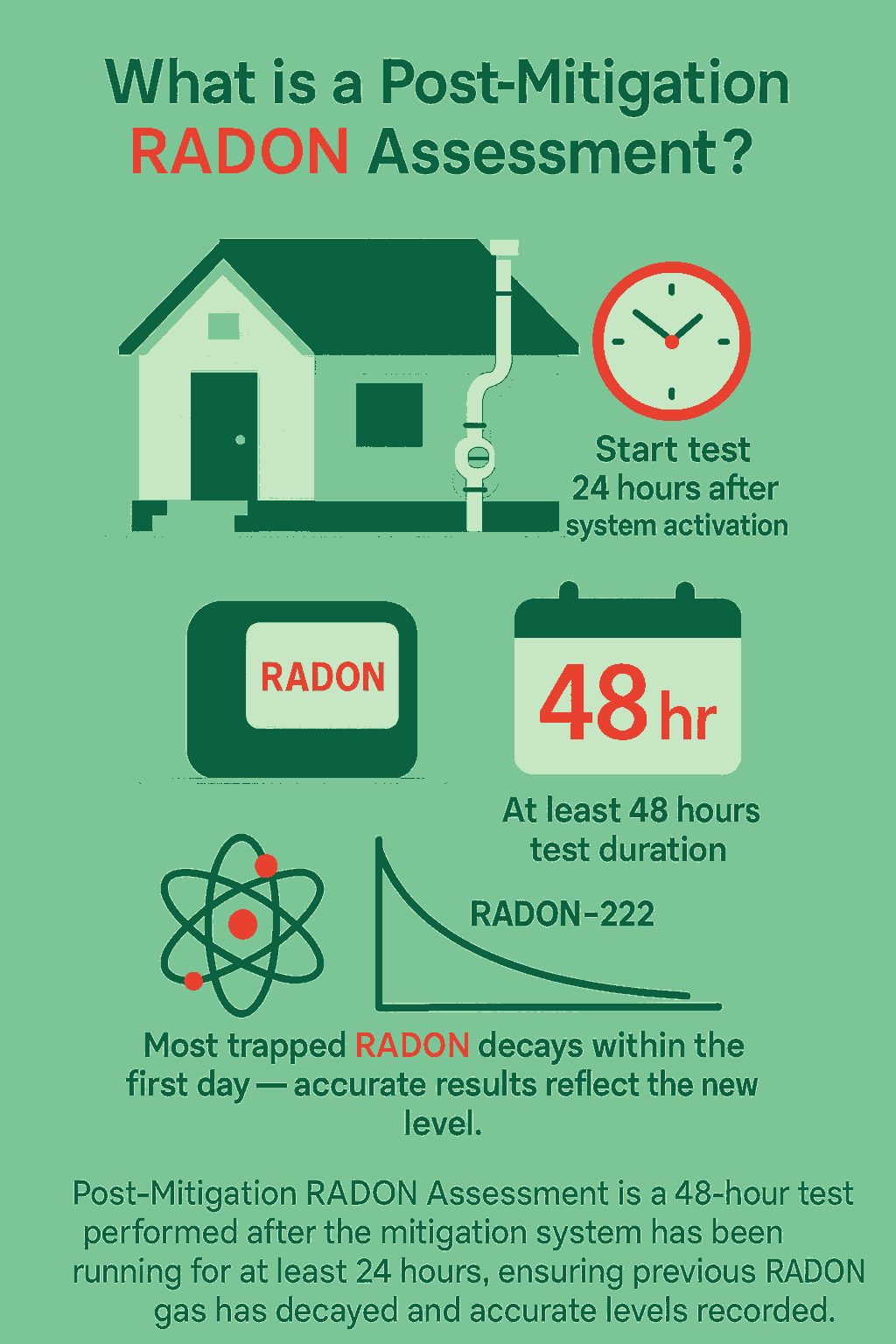
A Post-Mitigation RADON Assessment is a follow-up test done after installing a mitigation system to confirm that RADON levels have been effectively reduced.
The test should run for at least 48 hours and begin no sooner than 24 hours after the system is activated.
Since RADON-222 has a half-life of about 3.8 days, most of the gas already inside the home will naturally decay within the first day, allowing for an accurate reading of the new, reduced level.
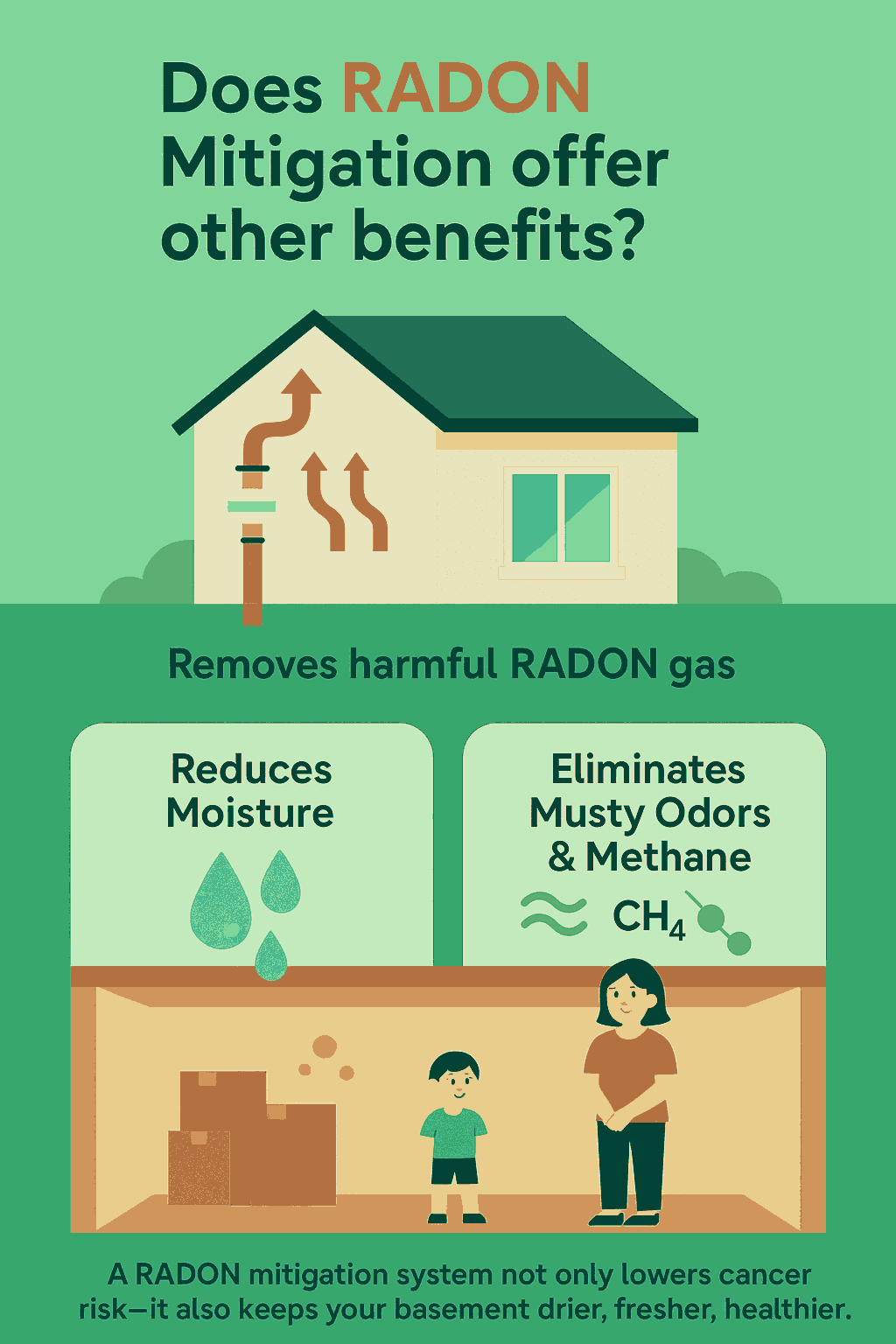
Yes. Besides reducing the risk of lung cancer, a RADON mitigation system can also help remove excess moisture, methane, and other soil gases from your home.
This can greatly improve air quality - especially in damp or musty basements, making the space fresher, drier, and more comfortable to live in.
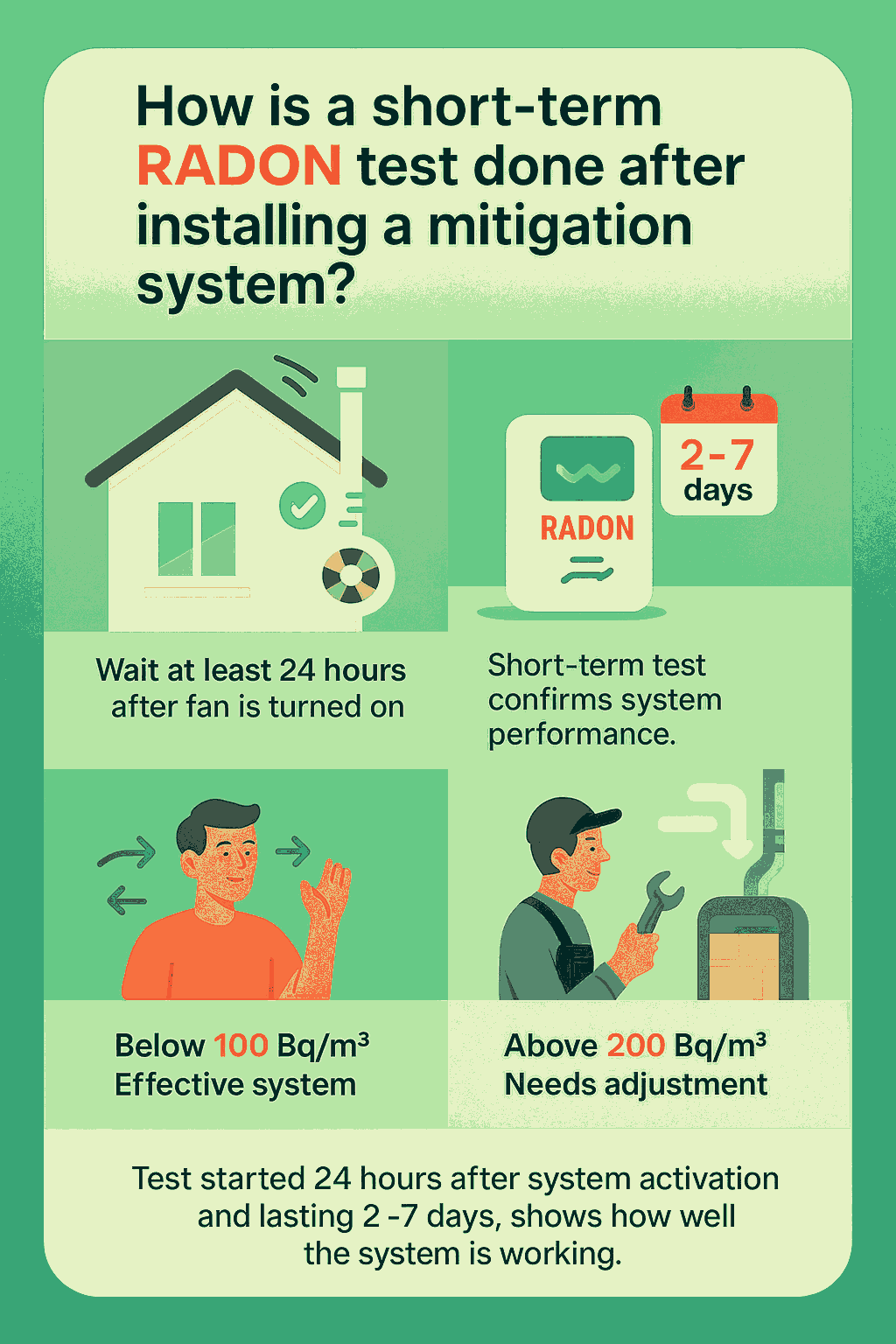
The test should begin at least 24 hours after the fan is turned on, allowing time for the home’s ventilation to clear out any remaining RADON.
The test usually runs for 2 to 7 days in the same location as the pre-mitigation test for accurate comparison.
If the RADON level is below 100 Bq/m³, the system is working effectively.
If it’s above 200 Bq/m³, further adjustments or repairs may be needed to improve performance.
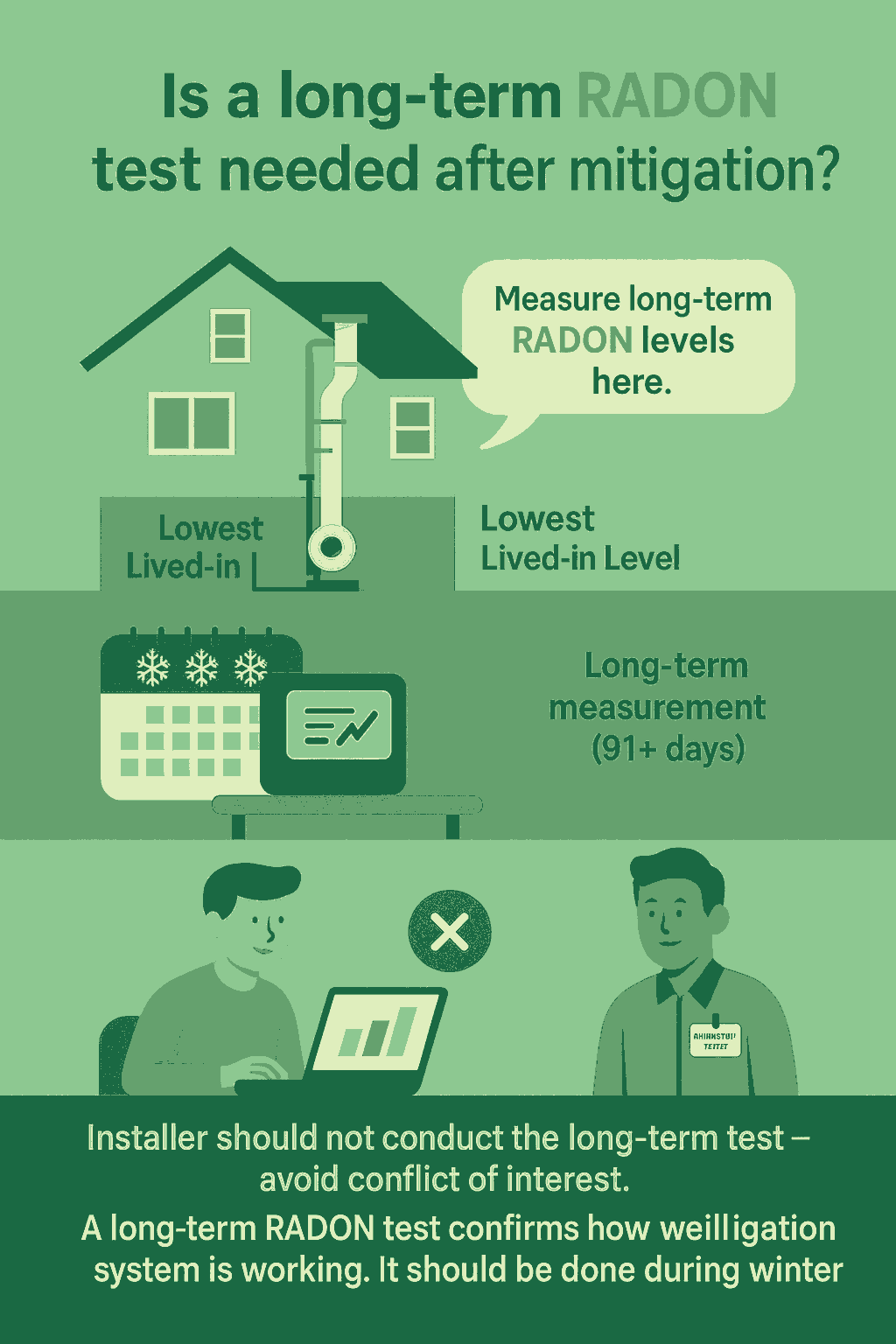
Yes. Health Canada recommends that the true effectiveness of a RADON mitigation system be confirmed with a long-term test in the same location as the original measurement - usually the lowest lived-in level of the home.
This test should be done during the winter, when indoor RADON levels are typically highest. It’s best for the homeowner or an independent tester (not the installer) to perform this test to ensure an unbiased result.
YES, you can.
Low-cost digital RADON monitors are available and show either a 7-day average or a total average since the device was powered on or reset.
They can be used for both short-term checks and long-term monitoring.
However, most models are not yet approved by the Canadian National Radon Proficiency Program (C-NRPP), and Health Canada does not currently recommend them for official testing.
Some models may provide reasonably accurate readings within an acceptable tolerance, but they should be used mainly for informational or screening purposes, not for certification or mitigation verification.
.png)
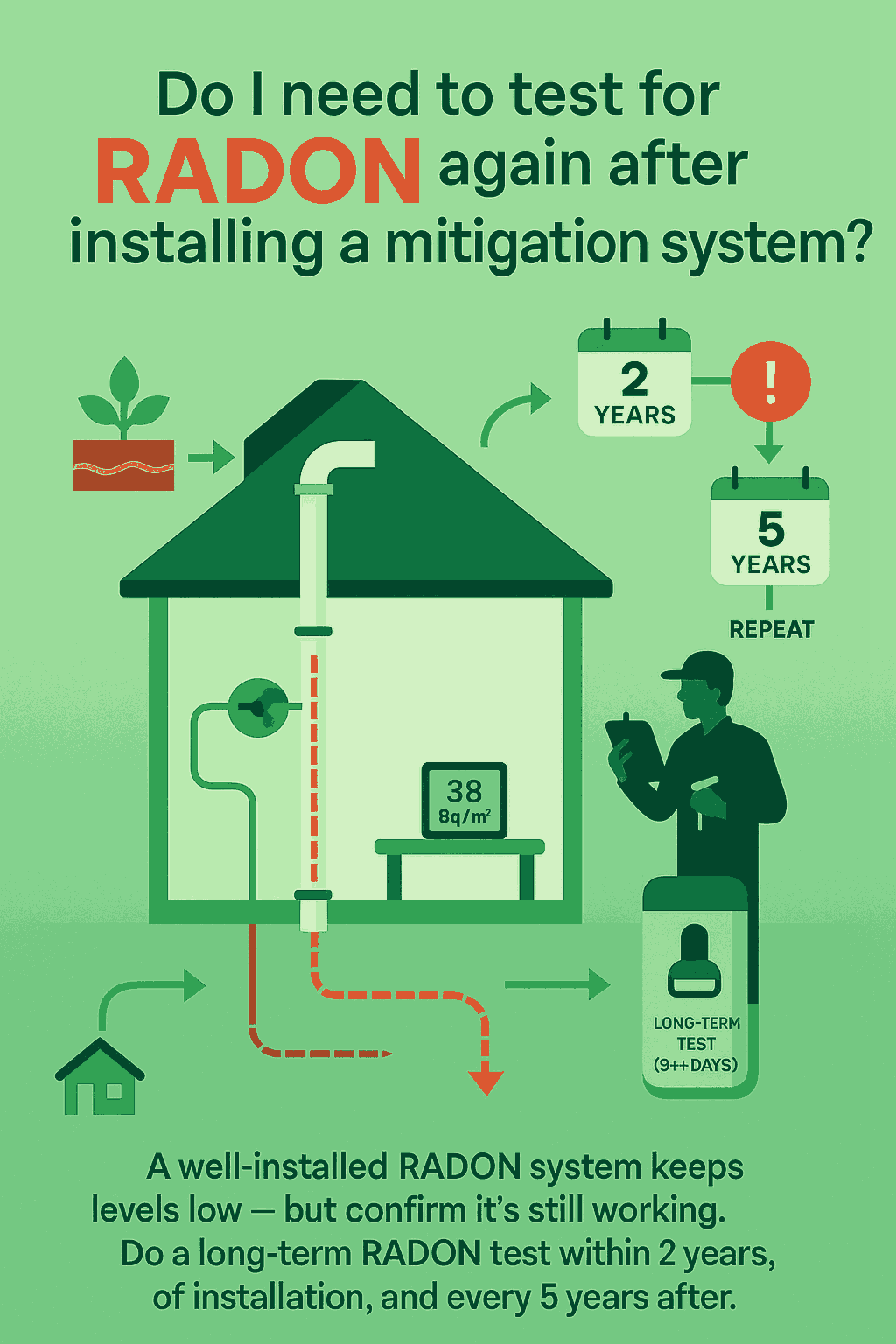
Yes. A properly installed system should keep RADON levels low as long as there are no major changes to your home, the soil, or the system itself.
To confirm continued performance, it’s recommended to do a long-term RADON test within two years of installation, and every five years after that.
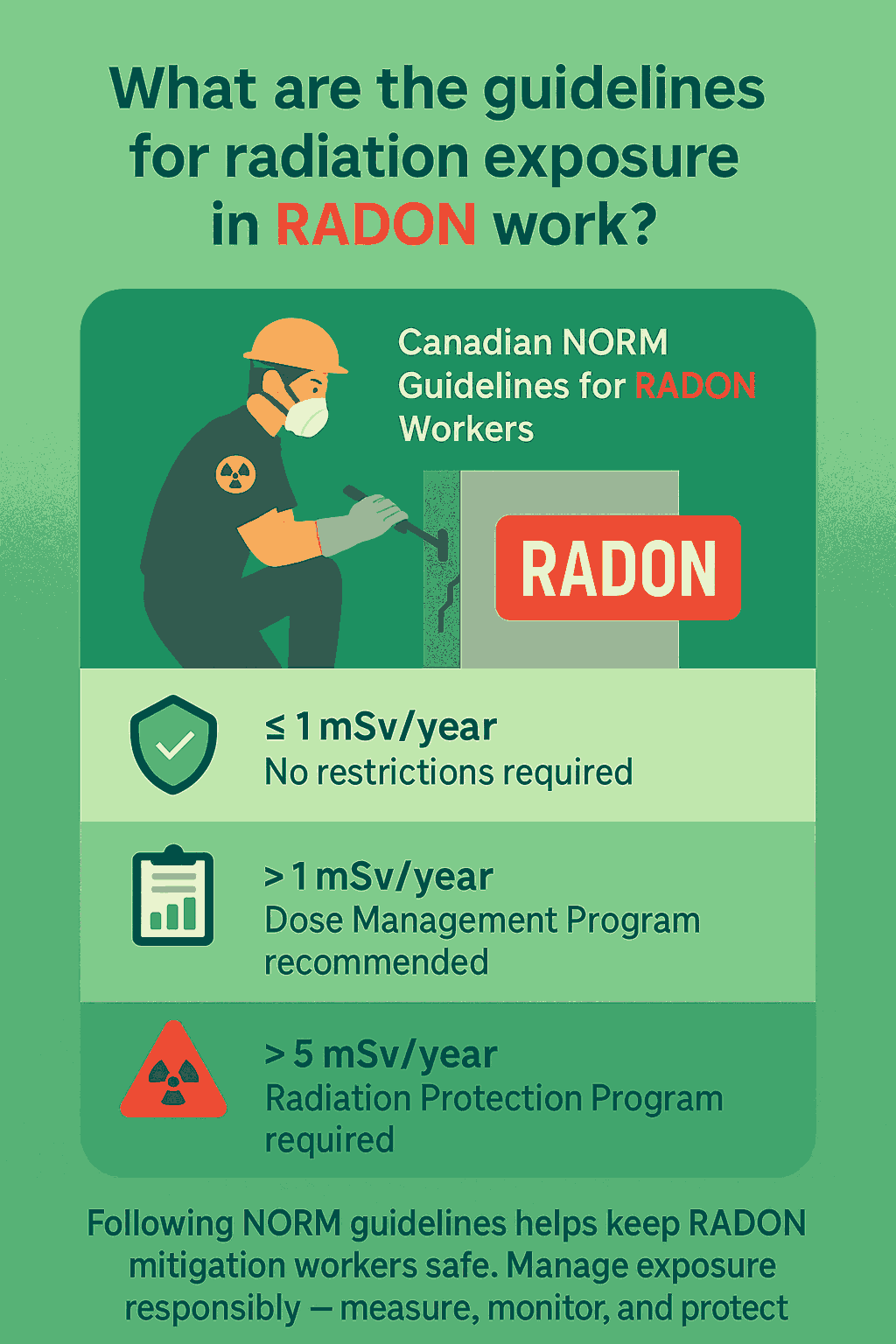
The Canadian Guidelines for the Management of Naturally Occurring Radioactive Materials (NORM) outline how to protect workers exposed to radiation sources such as RADON during their regular duties.
-
Below 1 mSv per year:
No special restrictions are needed.
-
Above 1 mSv per year:
A Dose Management Program is recommended to monitor exposure.
-
Above 5 mSv per year:
A Radiation Protection Program should be implemented for added safety.
These guidelines ensure that RADON mitigation professionals manage their exposure responsibly while maintaining safe working conditions.
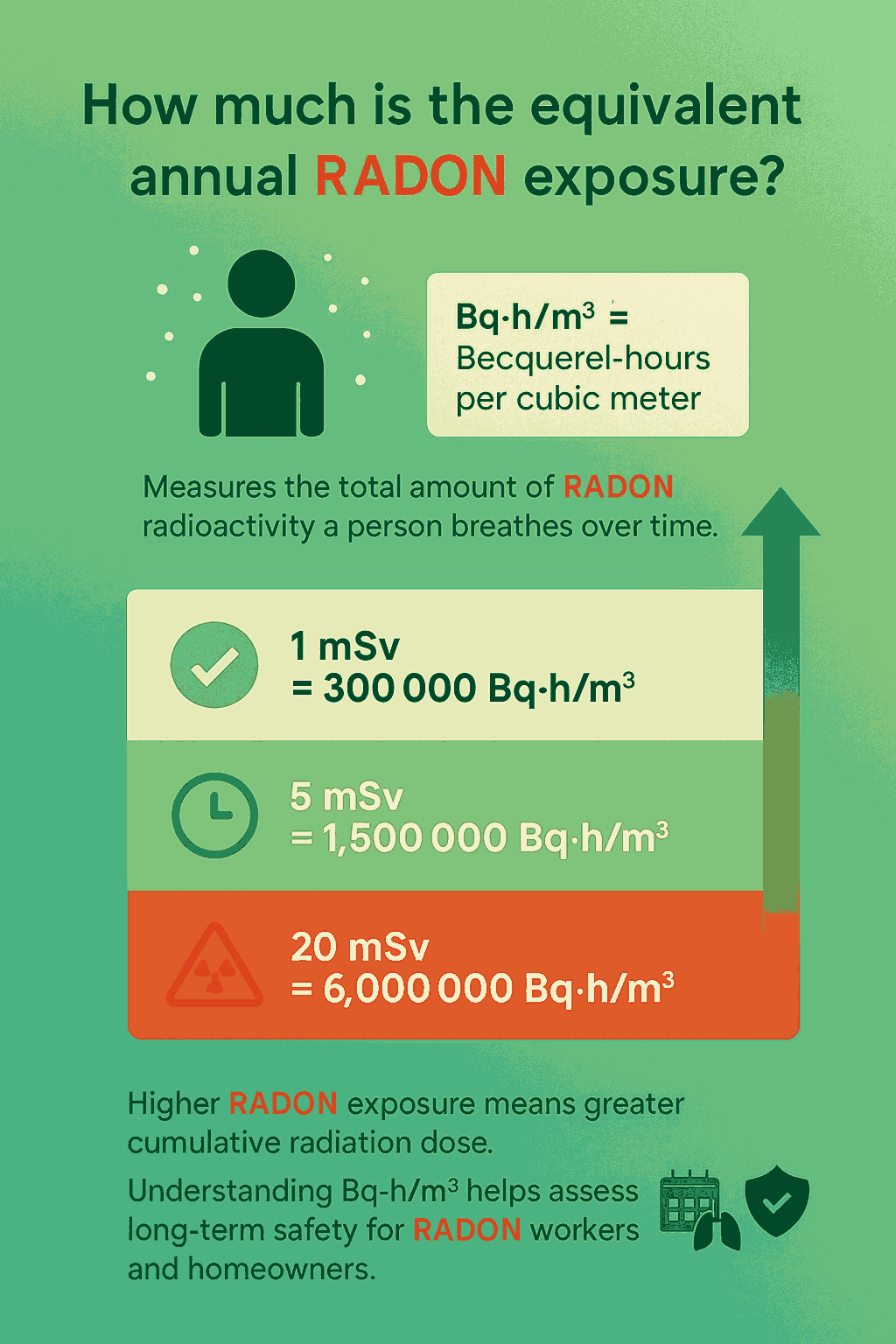
RADON exposure is often expressed as Bq·h/m³ (Becquerel-hours per cubic meter) - a measure of how much radon radioactivity a person is exposed to over time in a given space.
According to the annual effective dose:
- 1 mSv ≈ 300,000 Bq·h/m³
- 5 mSv ≈ 1,500,000 Bq·h/m³
- 20 mSv ≈ 6,000,000 Bq·h/m³
These values show how exposure levels increase with time and concentration - helping to understand the cumulative impact of long-term RADON exposure on health and safety.
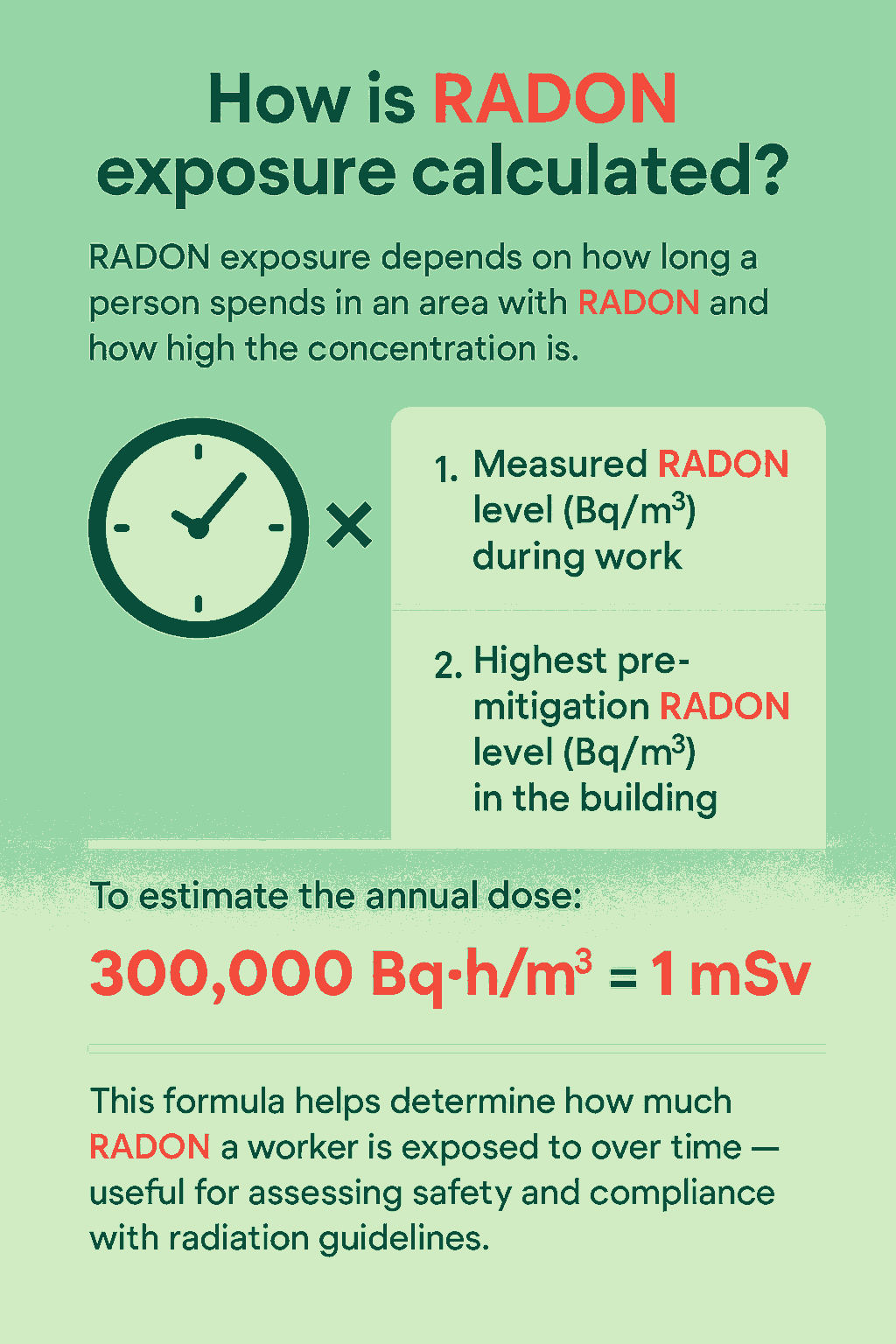
RADON exposure depends on how long a person spends in an area with RADON and how high the concentration is.
It’s calculated by multiplying the time spent (in hours) by either:
- The measured RADON level (Bq/m³) during work, or
- The highest pre-mitigation RADON level (Bq/m³) in the building.
To estimate the annual dose:
300,000 Bq·h/m³ = 1 mSv
This formula helps determine how much RADON a worker is exposed to over time - useful for assessing safety and compliance with radiation guidelines.