FAQ : About For New Built House
This section explains how RADON prevention and mitigation apply to Newly Built Homes.
You’ll learn about building code requirements, radon rough-in systems, and how preventive design features can help control RADON levels before a home is occupied.
These FAQs help builders, contractors, and homeowners understand the standards and best practices for RADON-resistant construction, ensuring a safe and healthy living environment from the very start.
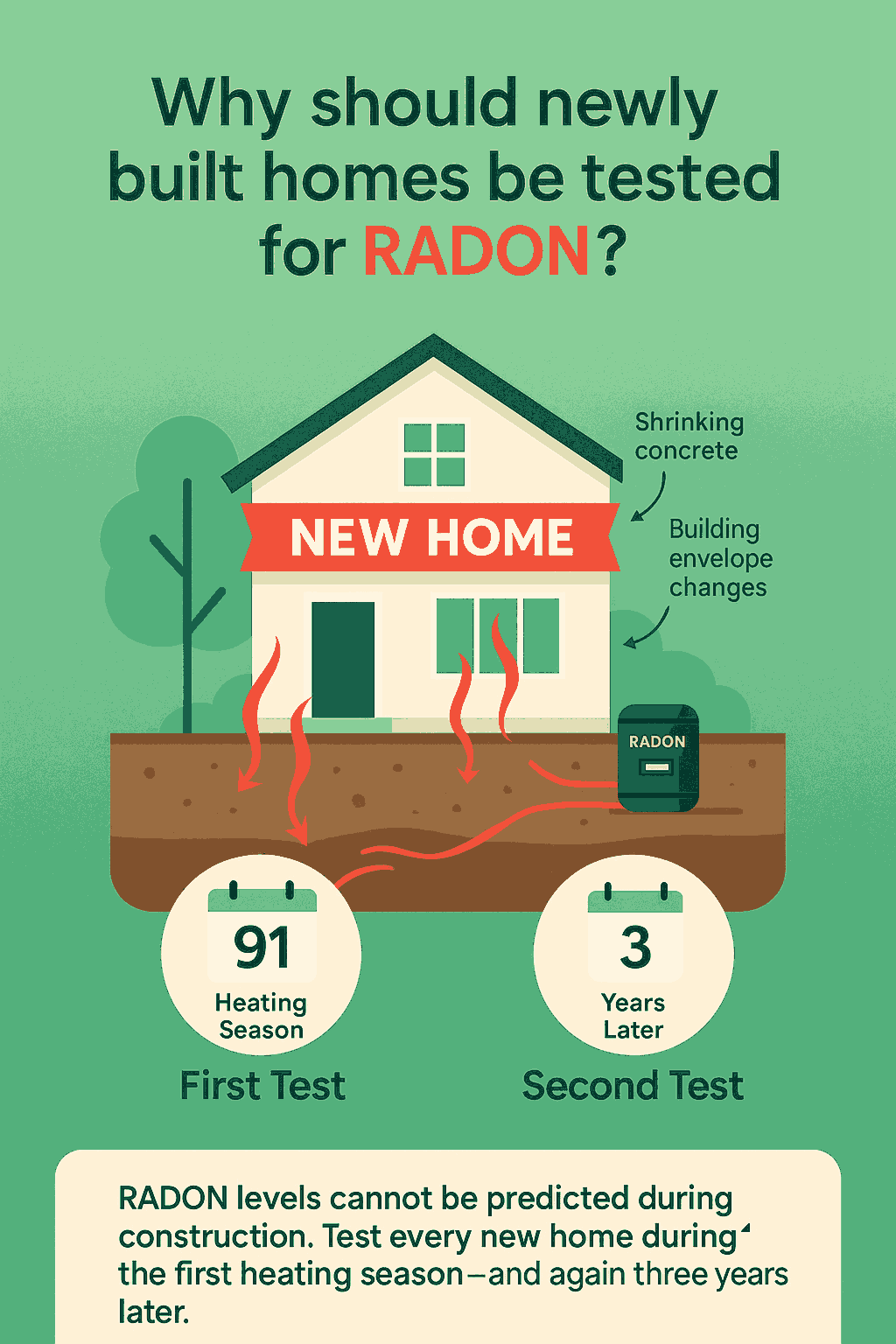
Even in brand-new homes, RADON levels cannot be predicted or measured during construction.
Every home is unique - soil gas, materials, and pressure differences affect RADON entry.
Homeowners should perform a long-term (91-day) RADON test during the first heating season after moving in.
Because new homes settle and concrete shrinks over time, it’s also recommended to test again during the heating season three years after construction.
For reliable results, use approved RADON test kits or certified professionals.
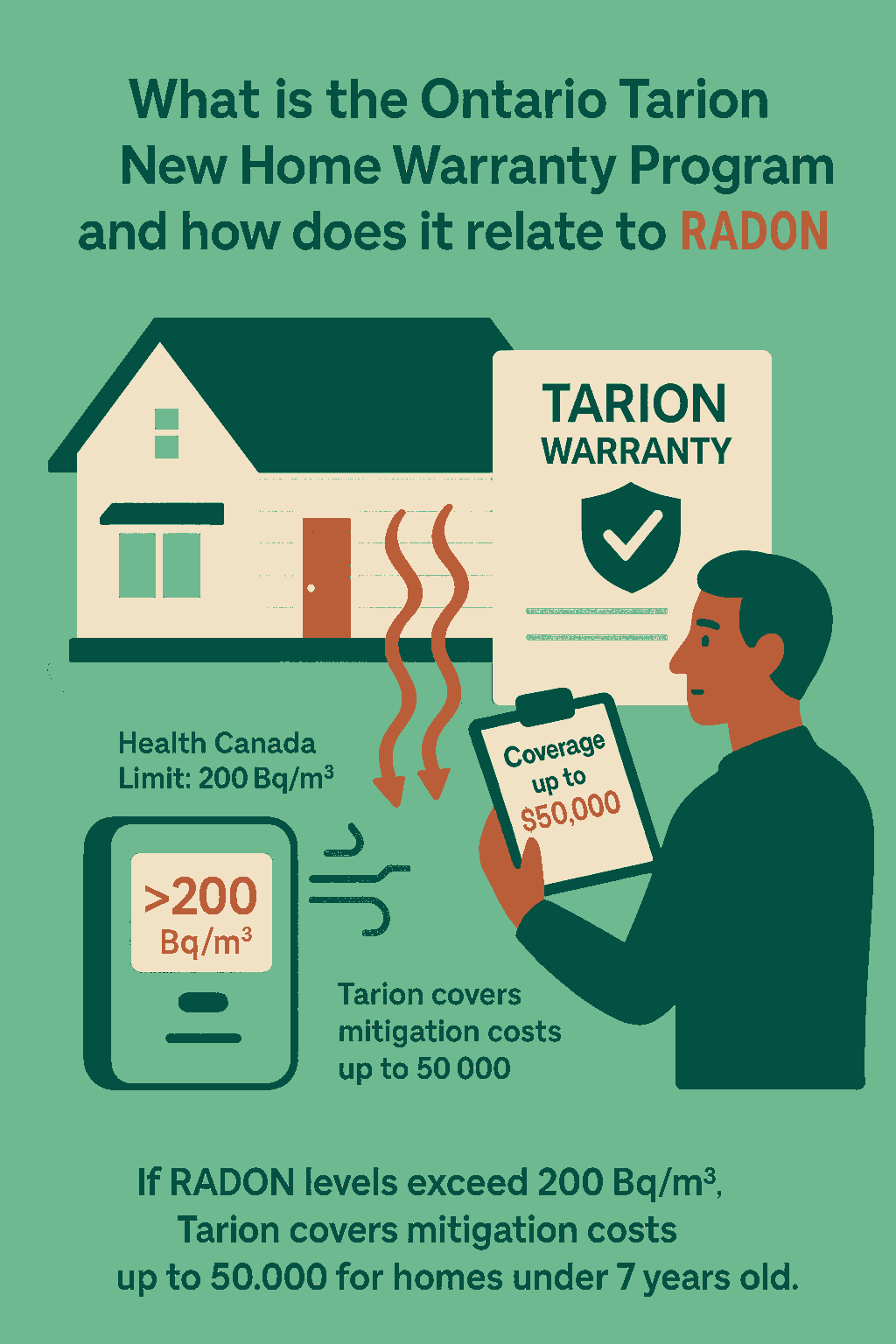
The Ontario Tarion New Home Warranty protects buyers of new homes by ensuring they receive coverage under their builder’s warranty.
Because RADON is recognized as a potential health risk, Tarion includes RADON mitigation coverage in its warranty program.
If a RADON test shows levels above 200 Bq/m³ (Health Canada’s limit), Tarion will cover the cost of mitigation up to $50,000.
If your home is less than 7 years old, you can contact Tarion to find out if your home qualifies for RADON coverage.
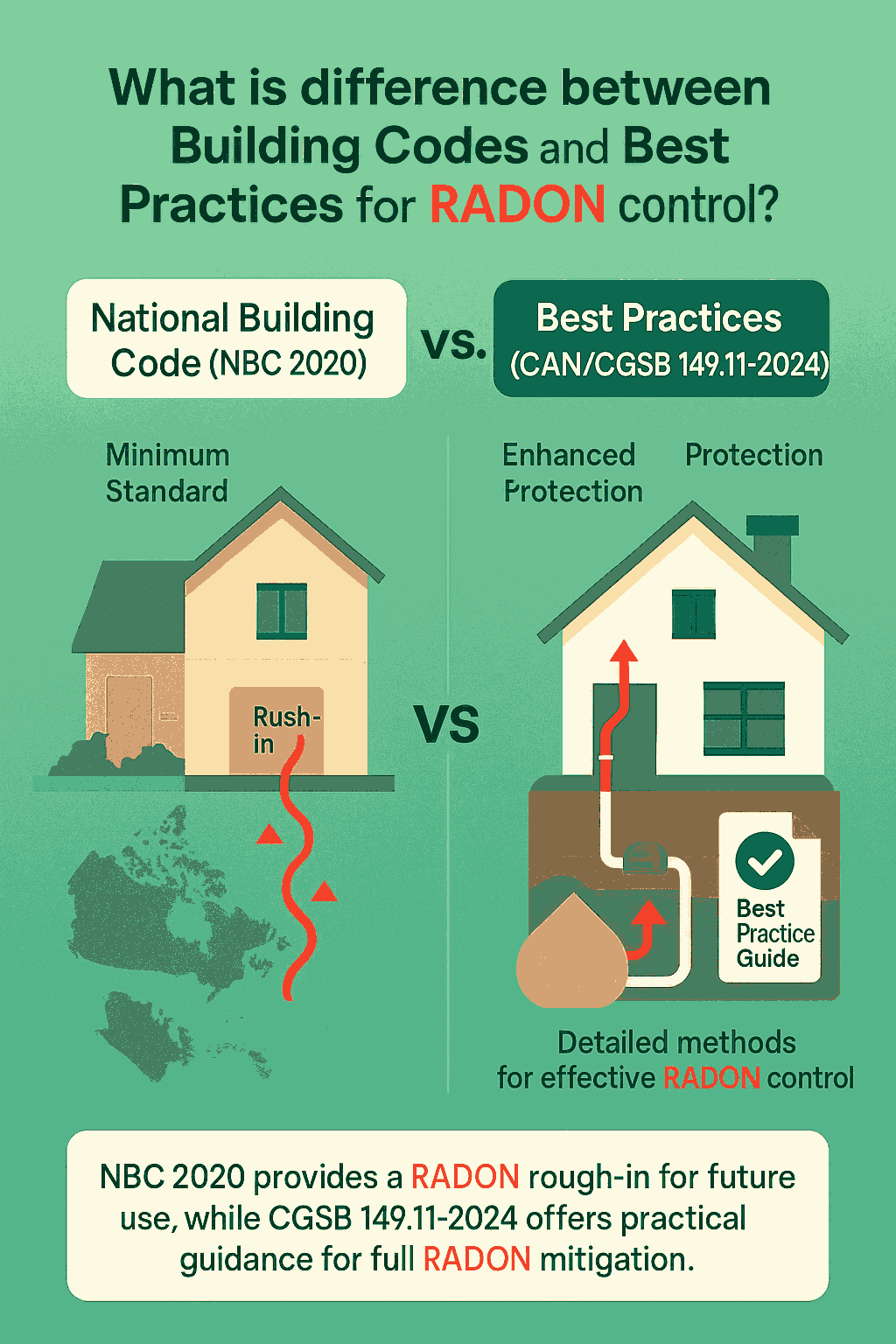
The National Building Code (NBC 2020) sets the minimum standard for all new homes in Canada. As of 2024, it applies to most provinces - but not yet in Ontario, and only partially in PEI and Newfoundland & Labrador.
NBC 2020 recognizes that homes may have high RADON levels, but it only requires builders to rough-in a system for future RADON reduction - it does not describe how to lower RADON levels.
For better protection, the Canadian General Standards Board (CGSB) published CAN/CGSB 149.11-2024 – Radon Control Options for New Buildings, a best practice guide that gives builders detailed methods to effectively manage and reduce RADON entry.
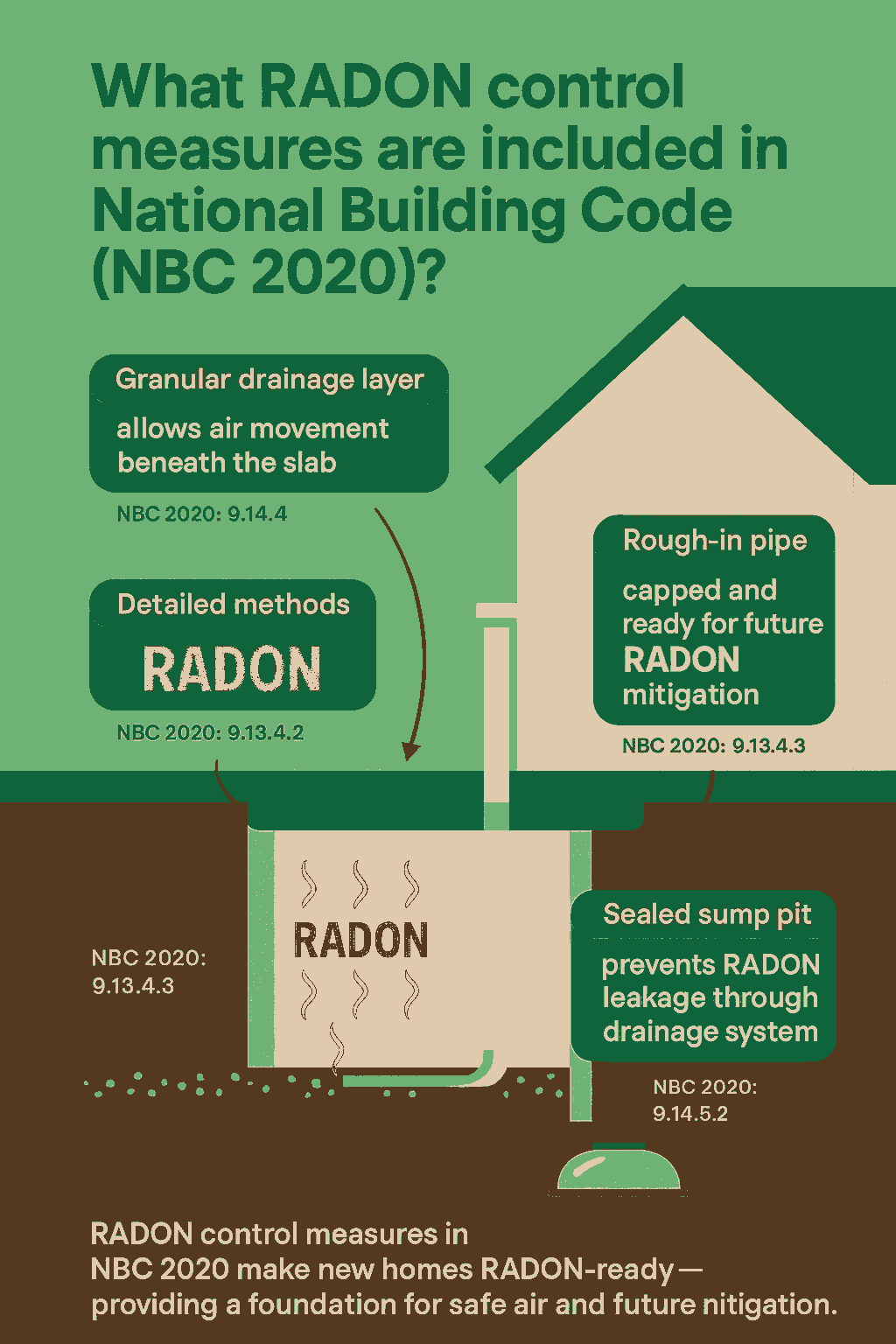
The NBC 2020 includes several key construction measures to help limit RADON entry into new homes. These measures prepare the building for safe ventilation and future mitigation if needed:
- Granular drainage layer under the slab
– Allows soil gas to move freely below the foundation. - Sealed sub-slab membrane
– All cracks and joints are sealed, and the membrane is sealed to foundation walls with flexible sealant. - Rough-in pipe system
– A capped vertical pipe connects the sub-slab layer to above the slab inside the home, ready for future RADON mitigation connection. - Sealed sump pit
– Prevents RADON and soil gases from leaking through the sump area.
These provisions make new homes RADON-ready, improving safety and long-term mitigation efficiency.
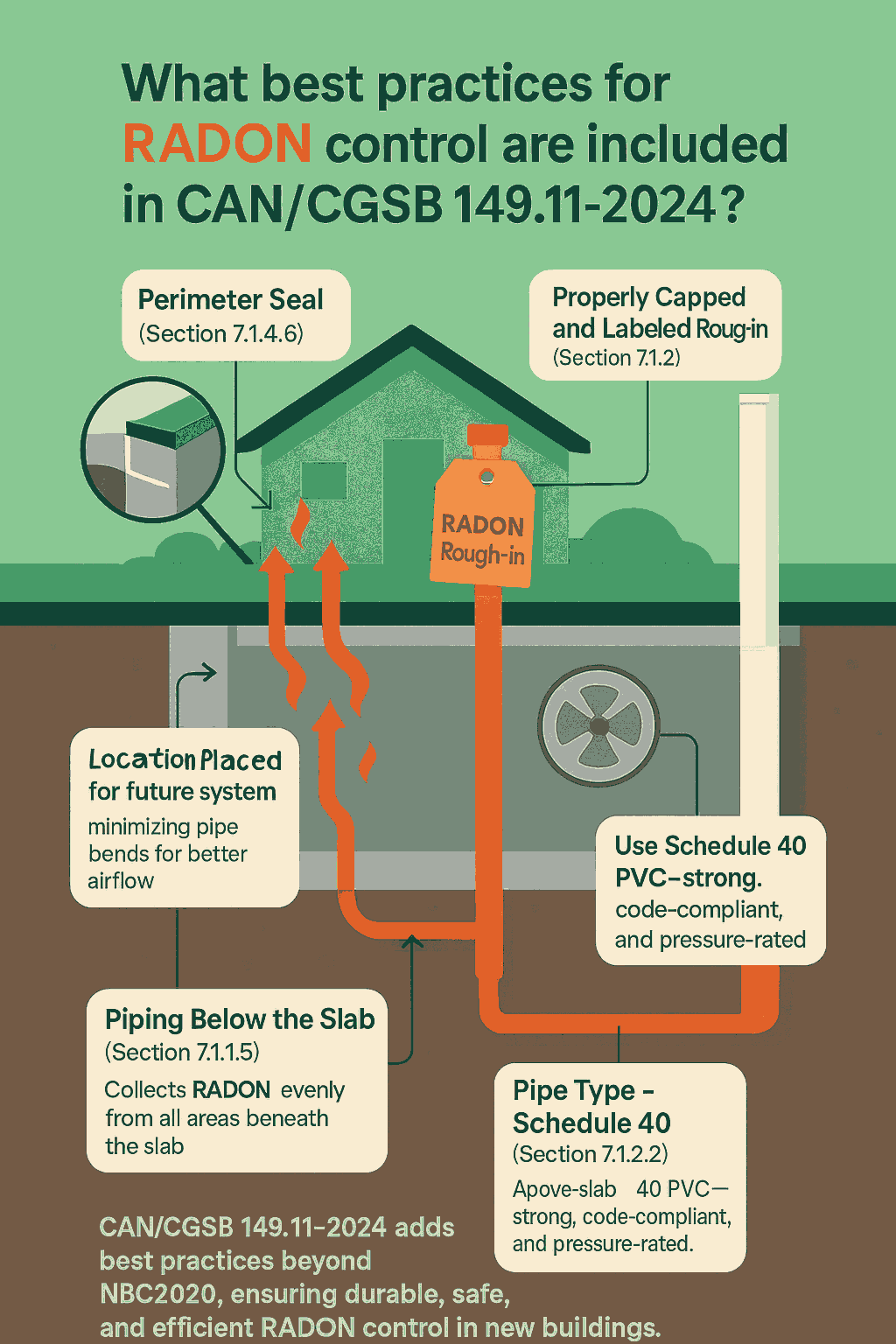
The CAN/CGSB 149.11-2024 standard provides best practices that go beyond the National Building Code (NBC 2020) to improve RADON prevention in new homes:
-
Perimeter sealing (Section 7.1.4.6)
– Properly seal the floor-to-wall joint and all perimeter areas.
– Sealing should allow for concrete shrinkage while maintaining flexibility. -
Location of the rough-in (Section 7.1.2)
– Install the pipe where a future mitigation system can be easily connected.
– Leave enough space for a fan (about 14” diameter) and plan an efficient path with minimal bends. -
Properly capped and labeled rough-in
– The rough-in pipe connects directly to the soil, so it must be airtight and sealed.
– Clearly label the pipe to inform current and future occupants of its purpose. -
Piping below the slab (Section 7.1.1.5)
– Use solid or perforated pipe depending on design.
– Ensure full sub-slab coverage, including across footings, and prevent pipe ends from being blocked. -
Pipe type for rough-in stub (Section 7.1.2.2)
– Above-grade portions must use Schedule 40 PVC or equivalent,meeting standards for wall thickness, diameter, and pressure rating.
These best practices ensure effective long-term RADON control and make new buildings safer and easier to upgrade if mitigation is needed.
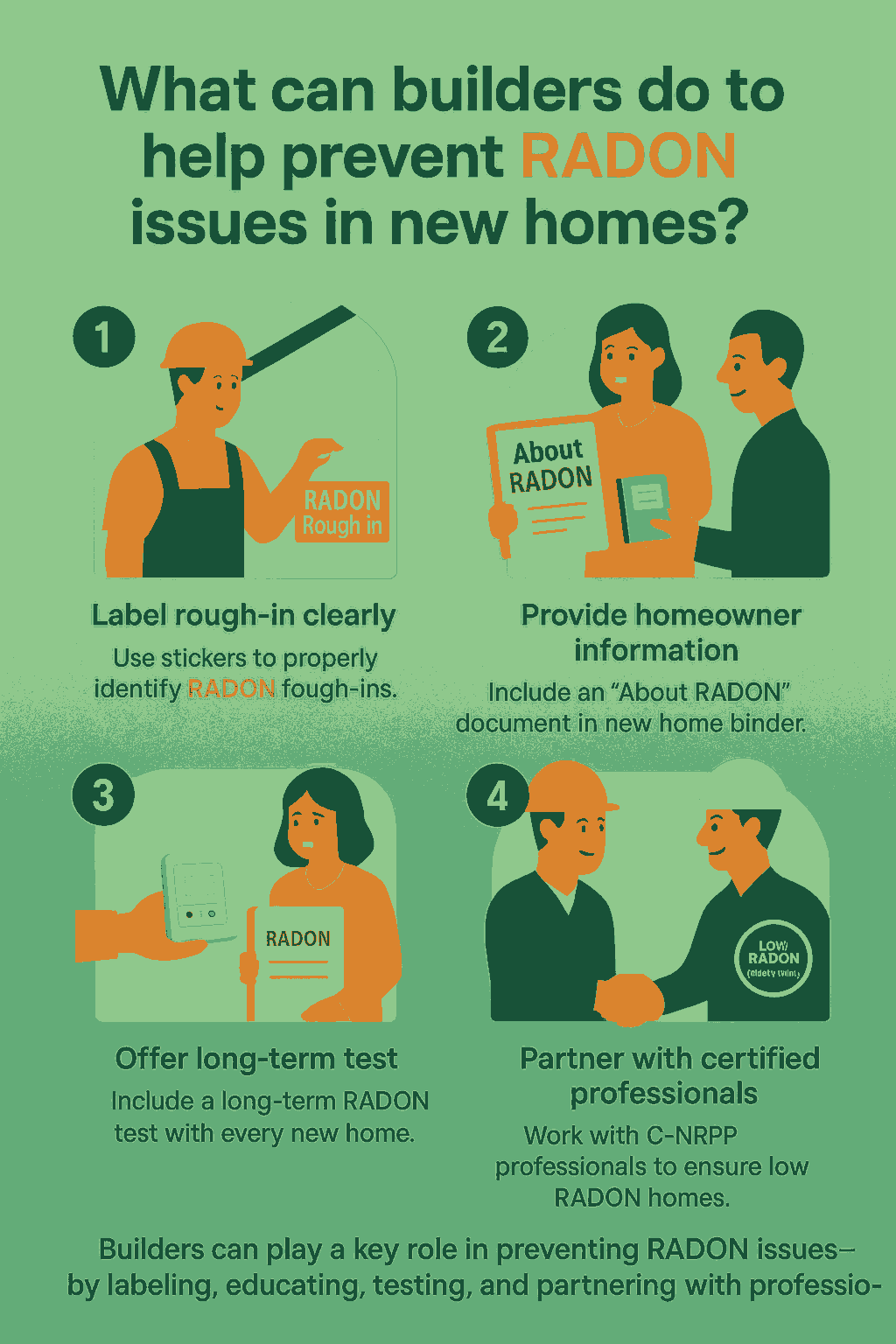
Builders can take simple, proactive steps to help ensure safe indoor air and protect homeowners from RADON:
-
Label rough-ins clearly
– Use durable stickers to mark RADON rough-in pipes for easy identification. -
Provide homeowner information
– Include an “About RADON” document in the new home binder to educate buyers. -
Offer a long-term test
– Add a RADON test kit with every new home to confirm safe levels. -
Work with professionals
– Partner with C-NRPP-certified RADON experts to offer homes with a low-RADON guarantee.
These steps build trust, promote safety, and show a builder’s commitment to healthy living.